Yes — September falls inside the most productive stretch of the Galápagos cetacean calendar, though the species you are most likely to encounter are not the ones most visitors expect. The archipelago sits at the convergence of three major ocean currents, and by September the cold, nutrient-dense Humboldt Current and the subsurface Cromwell Current are at their strongest influence. That combination drives plankton blooms, concentrates schooling fish, and draws baleen whales, toothed whales, and large dolphin pods into a relatively small band of water on the western edge of the archipelago.
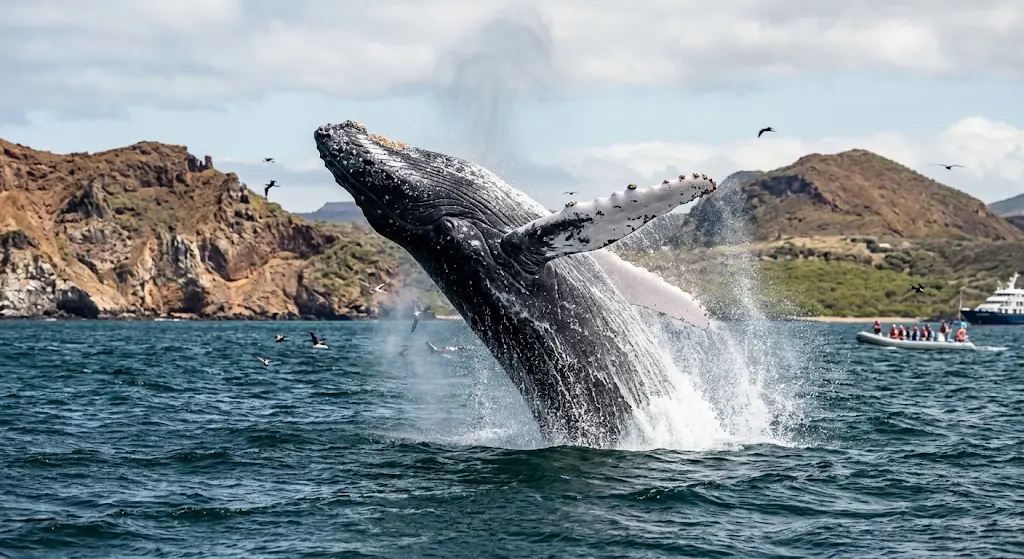
The practical answer, however, depends heavily on where your itinerary actually goes. Whale activity in Galápagos is geographically concentrated rather than evenly distributed. The Bolívar Channel — the strait separating Isabela from Fernandina — accounts for a disproportionate share of confirmed sightings, and most single-day excursions departing from Puerto Ayora or Puerto Baquerizo Moreno never reach it. Understanding that distinction is the difference between a realistic expectation and a disappointed one.
This guide outlines which species are present in September, why cold-season oceanography concentrates them, what sea conditions to expect during the garúa season, and what Galápagos National Park regulations permit during a cetacean encounter. For broader seasonal context beyond whales, see our overview of visiting Galápagos in September.
| Specification / Metric | Detail / Value |
|---|---|
| Peak cetacean window | June to November; September near the seasonal maximum |
| Most frequently seen baleen whale | Bryde’s whale (Balaenoptera edeni) — resident year-round |
| Occasional large species | Blue whale, sperm whale, humpback, minke, sei, orca |
| Prime waters | Bolívar Channel, Punta Vicente Roca, Elizabeth Bay, Fernandina coast |
| Sea surface temperature | 20–24 °C centrally; 16–19 °C in western upwelling zones |
| Air temperature range | Roughly 19–26 °C, frequent overcast skies and drizzle |
| Sea state | Moderate to choppy; southeast trade winds strongest of the year |
| Minimum approach distance | 100 metres from any whale; no engine-off drifting into their path |
| Swimming with whales | Prohibited under Galápagos National Park regulations |
| Best access | Western-route liveaboard cruise; limited from day-tour ports |
| Essential gear | Windproof layer, 3–5 mm wetsuit for snorkelling, binoculars, motion-sickness medication |
Why Cold-Water Upwelling Turns September into Cetacean Season
Galápagos sits roughly 900 kilometres off mainland Ecuador at the meeting point of the Humboldt, Panama, and South Equatorial currents. Below the surface, the Cromwell Current — an eastward-flowing equatorial undercurrent — strikes the steep submarine flank of Isabela and Fernandina and deflects upward. This forced upwelling delivers cold, nutrient-rich water into the sunlit zone, triggering phytoplankton production that supports krill, sardines, and mackerel.
Between June and November, the garúa season strengthens this process. Southeast trade winds intensify, sea surface temperatures drop, and the thermocline shallows. By September the western archipelago functions as a concentrated feeding ground, which is why baleen whale sightings cluster there rather than around the central islands. The same productivity explains the seasonal abundance of Galápagos penguins, flightless cormorants, and marine iguanas along that same coastline — a pattern documented across many of the endemic species found throughout the islands.
Which Whale Species Actually Appear in September
The Bryde’s whale is the species visitors most reliably encounter. Unlike migratory baleen whales, it maintains a resident presence in Galápagos waters year-round, feeding on schooling fish and krill. Adults reach 13–15 metres and often surface in shallow, unpredictable arcs rather than performing deep fluking dives, which makes them easy to miss without an experienced spotter.
Blue whales — the largest animals on Earth — are recorded most often during the cool season, feeding along the western upwelling front. Sightings remain uncommon but are meaningfully more probable in September than in March. Sperm whales also occur, primarily off Isabela and Fernandina; the archipelago was a major nineteenth-century whaling ground for exactly this reason, a history still marked at Floreana’s Post Office Bay, a stop included on the Floreana Island land tour.
Humpback whales generate the most questions, and here accuracy matters. Ecuador’s principal humpback breeding ground is the mainland coast around Puerto López and Machalilla, not the archipelago. Humpbacks do transit Galápagos waters between roughly June and October, but sightings are opportunistic rather than predictable. Travellers whose primary goal is guaranteed humpback watching are better served by a mainland coastal excursion.
Orcas are present as a small resident population and prey on sea lions, dolphins, rays, and ocean sunfish. Encounters are rare but occur across the archipelago. Large pods of common and bottlenose dolphins are far more frequent and often ride bow waves during inter-island crossings.
Bolívar Channel and the Access Problem for Day Trippers
The narrow strait between Isabela and Fernandina — the Bolívar Channel — concentrates upwelled water, and with it, feeding cetaceans. Punta Vicente Roca on Isabela’s northwestern hook and the waters off Punta Espinoza on Fernandina are the two highest-yield observation zones. Both are visited almost exclusively by multi-day western-route cruises, because the distance from the inhabited ports makes a same-day return impractical.
This creates a realistic constraint. Visitors basing themselves in Puerto Ayora or Puerto Baquerizo Moreno and building an itinerary from single-day excursions will still see dolphins, sea lions, and abundant seabirds, and may encounter a Bryde’s whale during longer navigations toward sites such as Kicker Rock or Pinzón Island. But those encounters are incidental. Anyone treating whales as the trip’s central objective should plan around a western itinerary, or base themselves on Isabela, where excursions such as Los Túneles at Cabo Rosa at least place you on the correct side of the archipelago.
Sea Conditions, Water Temperature, and Visibility During the Garúa
September delivers the archipelago’s coolest water and its roughest surface conditions simultaneously. Central-island sea temperatures typically sit between 20 and 24 °C, while the western upwelling zones can fall to 16–19 °C. A 3–5 mm wetsuit is not optional for extended snorkelling in these months, and most operators provide one.
Underwater visibility is more variable than during the warm season. Heavy plankton loads that attract whales also reduce clarity, occasionally to under ten metres. In exchange, marine life density rises sharply — larger schools of fish, more active sea lions, and more frequent ray aggregations at sites covered in our guide to the best beaches and snorkelling spots.
Above water, expect persistent overcast skies, drizzle in the highlands, and steady southeast winds. Crossings are noticeably choppier than between January and May, and motion-sickness preparation is genuinely advisable for anyone sensitive to swell. September is also the height of sea lion pupping and territorial activity, detailed in our guide to where to see sea lions in September.
How the National Park Regulates Whale Encounters
Cetacean observation in Galápagos operates under strict controls administered by the Galápagos National Park Directorate. Vessels must maintain a minimum distance of 100 metres from any whale, approach on a parallel course rather than head-on, and never position themselves between a mother and calf. Sudden speed or direction changes within the observation zone are prohibited.
Swimming with, touching, or feeding whales is forbidden, without exception. Observation time is limited, and the number of vessels permitted near a single animal is capped to prevent crowding. Drone operation requires specific authorisation and is restricted across most visitor sites.
All excursions must be accompanied by a certified naturalist guide, and itineraries are pre-assigned to distribute pressure across sites. These measures reflect a broader management principle: within the Galápagos Marine Reserve, which spans roughly 133,000 square kilometres, wildlife behaviour takes precedence over visitor access.
Practical Planning for a September Whale-Focused Trip
Choose a vessel with an outdoor upper deck and unobstructed sightlines — enclosed fibreglass speedboats are poor observation platforms. Binoculars in the 8×42 range are the single most useful item you can pack. For photography, a 100–400 mm zoom handles distant blows far better than a fixed lens.
Layer for wind rather than heat: a windproof shell, a fleece or long-sleeve base layer, and a hat are more valuable in September than in any other month. Reef-safe sunscreen remains necessary despite the cloud cover, since ultraviolet levels at the equator stay high through overcast conditions. Dry bags protect electronics during wet landings and spray-heavy crossings.
Finally, scan continuously rather than intermittently. Bryde’s whales surface briefly and without dramatic display; most sightings begin as a low, bushy blow noticed by someone actually watching the horizon. Central-island itineraries such as the North Seymour day tour still offer excellent September wildlife density, even if large cetaceans remain a bonus rather than a guarantee.
Final Thoughts
September occupies a specific and valuable position in the Galápagos calendar. The oceanographic conditions that make the water cold and the crossings rough are the same conditions that make the archipelago biologically exceptional during these months. Upwelling converts a nutrient-poor equatorial ocean into one of the most productive marine systems on the planet, and cetaceans are the most visible expression of that transformation. Understanding this relationship reframes the question — whale presence is not a matter of luck alone, but a predictable consequence of where cold water rises.
The honest limitation is geographic. The archipelago’s whale activity is concentrated along its western margin, and the standard visitor infrastructure is concentrated in the central and southeastern islands. That mismatch explains most disappointed expectations. A traveller who plans around a western route, or who treats cetacean sightings as one component of a broader wildlife itinerary rather than its purpose, will consistently have a better experience than one who assumes whales are visible from any boat on any day.
Beyond the individual trip, September conditions serve as an ecological indicator. The strength of the Cromwell upwelling varies year to year, and El Niño events can suppress it substantially, reducing productivity and dispersing feeding aggregations. Long-term monitoring of cetacean presence in the Bolívar Channel therefore contributes data on ocean-climate variability across the eastern tropical Pacific. What visitors observe from a deck rail in September is, in a real sense, a readout of the current’s condition that year.
Frequently Asked Questions About Whale Watching in Galápagos in September
Are humpback whales guaranteed in Galápagos during September?
No. Humpbacks transit Galápagos waters roughly between June and October, but the archipelago is not their primary breeding ground — that role belongs to Ecuador’s mainland coast near Puerto López and Machalilla. Galápagos humpback sightings are opportunistic. If humpbacks are your central goal, a mainland coastal excursion offers far higher reliability than an island itinerary.
Which whale is most commonly seen in the archipelago?
The Bryde’s whale, a resident species present year-round. It feeds on schooling fish and krill and is encountered most often in the productive western waters. Bryde’s whales surface in shallow arcs without the dramatic tail-fluking of humpbacks, so sightings depend significantly on having an attentive guide and clear sightlines from the vessel.
Can you swim or snorkel with whales in Galápagos?
No. Galápagos National Park regulations prohibit entering the water with whales, as well as touching or feeding them. Vessels must stay at least 100 metres away, approach on a parallel course, and avoid positioning between mothers and calves. These rules are enforced by certified naturalist guides who accompany every excursion.
Can day tours from Santa Cruz or San Cristóbal reach the best whale waters?
Generally no. The highest-yield zones — the Bolívar Channel, Punta Vicente Roca, and the Fernandina coast — are too distant from the inhabited ports for same-day return trips. Day tours from these bases offer excellent seabird, sea lion, and dolphin encounters, and occasional incidental whale sightings, but consistent whale watching requires a western-route multi-day cruise.
How cold is the water and what wetsuit thickness is needed?
Central-island sea temperatures typically range from 20 to 24 °C in September, dropping to 16–19 °C in the western upwelling zones. A 3 mm wetsuit is adequate for central sites, while 5 mm is preferable for extended snorkelling in western waters. Most licensed operators include wetsuit rental, but confirming thickness in advance is worthwhile.
Is September worth visiting given the rough seas?
For wildlife-focused travellers, yes. September delivers peak marine productivity, high concentrations of fish and marine mammals, active sea lion colonies, and fewer crowds than the December–January or June–August peaks. The trade-offs are choppier crossings, cooler water, overcast skies, and more variable underwater visibility. Motion-sickness medication and windproof clothing address most of the discomfort.