A sea lion pup once fell asleep on my dry bag in Puerto Baquerizo Moreno while I was still holding it. Nobody around me looked up. On San Cristóbal that is a Tuesday, and it explains something the brochures never quite land: the species list is not what makes the Galápagos extraordinary. The indifference does. These animals evolved without wolves, jaguars, or people, and they have never learned to run.
Roughly 906 kilometres of open Pacific separate the archipelago from mainland Ecuador. Everything that lives here either flew, swam, or floated across on a raft of tangled vegetation, then survived long enough to breed. That filter was brutal. It let through reptiles with slow metabolisms and seabirds with long wings, and it drowned nearly every land mammal that tried. What arrived then split, shrank, grew, lost the ability to fly, and in one famous case took up drinking blood.
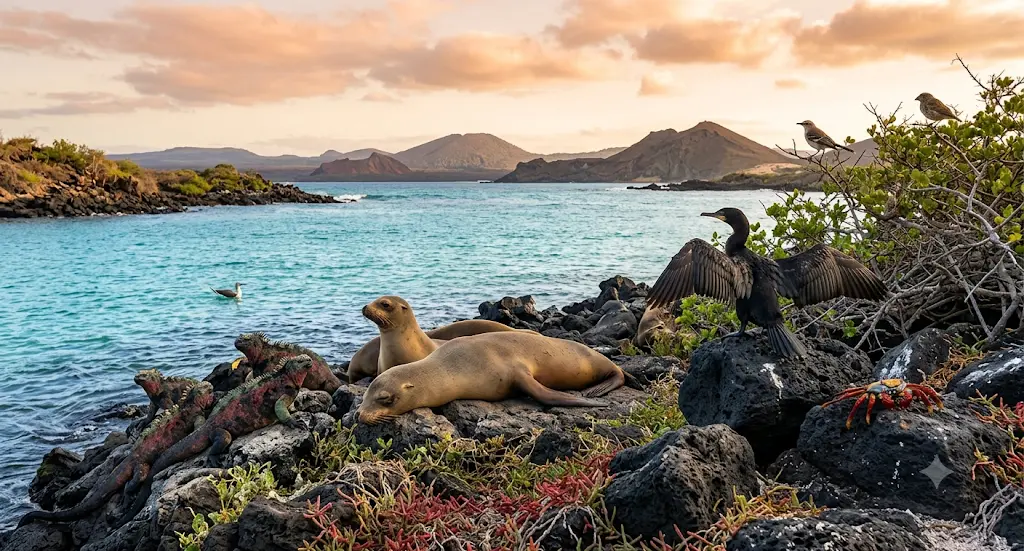
Around 97% of the archipelago’s reptiles and land mammals live nowhere else on Earth, along with roughly 80% of its land birds and a quarter of its shore fish. This guide covers the animals you will actually meet — the tortoises, the iguanas, the boobies, the crabs, the sea lions — how each one got here, what it does all day, and which islands give you the best odds.
Quick Facts About Galápagos Wildlife
| Attribute | Detail |
|---|---|
| Location | Pacific Ocean, ~906 km west of mainland Ecuador, straddling the Equator |
| Land area | ~7,880 km² across 13 major islands, 6 smaller ones and 100+ islets |
| Endemism | ~97% of reptiles and land mammals; ~80% of land birds; ~20–25% of shore fish |
| Largest animal on land | Galápagos giant tortoise (Chelonoidis spp.), up to 1.8 m and 400 kg |
| Longest-lived species | Giant tortoise, commonly 100+ years, with credible records above 150 |
| Only sea-going lizard on Earth | Marine iguana (Amblyrhynchus cristatus) |
| Only tropical penguin | Galápagos penguin (Spheniscus mendiculus), ~49 cm, 2–2.5 kg |
| Typical diets | Cactus and grasses (tortoises, land iguanas); marine algae (marine iguanas); fish, squid and crustaceans (seabirds, sea lions, penguins) |
| Conservation status | Mixed. Waved albatross and several tortoise lineages are Critically Endangered; sea lion, fur seal and penguin are Endangered; marine iguana is Vulnerable |
| Protection | National Park since 1959; UNESCO World Heritage since 1978; marine reserve of 133,000 km², expanded in 2022 by a further 60,000 km² |
| Defining trait | Ecological naïveté — almost no species here evolved a fear response to large mammals, including us |
Evolutionary Origins: How Anything Got Here at All
The Galápagos sit over a volcanic hotspot. Magma punches through the Nazca Plate, builds an island, and the plate then carries that island slowly southeast while a new one rises behind it. Española and San Cristóbal in the east are the elders at roughly 3–4 million years. Fernandina in the west is a toddler, under a million years old and still erupting — it last did so in 2024.
No land bridge ever connected this archipelago to South America. Colonists had three options. Fly, and the seabirds and finches did. Swim, and the sea lions and turtles did. Or float, which is where the story gets strange. Rafts of matted vegetation regularly wash out of the Guayas and Esmeraldas rivers, and the Panama and Humboldt currents deliver them west. A reptile on such a raft has a fighting chance because it needs almost nothing. A tortoise can survive months without food or fresh water, and its shell floats.
Mammals, with their fast metabolisms and constant thirst, mostly died at sea. That absence shaped everything. With no browsing deer, no cats, no competition, tortoises took the herbivore niche and grew enormous — island gigantism, the same process that produced Komodo dragons. With no ground predators, cormorants stopped needing to escape and their wings withered to a third of the span required for flight.
Charles Darwin spent five weeks here in 1835 aboard HMS Beagle, and he was slower to see the pattern than the legend suggests. The mockingbirds bothered him first; he noticed they differed island to island and wondered whether that undermined the fixity of species. His finch specimens were a mess, poorly labelled, and it took the ornithologist John Gould back in London to sort them into distinct species. Vice-Governor Nicholas Lawson had already told Darwin he could name a tortoise’s home island from the shape of its shell. Darwin filed the remark away. Twenty-four years later it turned up, quietly, inside On the Origin of Species.
Physical Characteristics of Galápagos Animals
Shell shape is the clearest field mark in the archipelago. On wet, high islands like Santa Cruz where vegetation grows at ground level, tortoises carry domed shells and short necks. On dry, low islands like Española and Pinzón, where food means reaching up into cactus, they evolved saddleback shells — the front of the carapace flares upward like a saddle, freeing a long neck to stretch nearly vertical. Same ancestor, opposite silhouette, and the difference tracks rainfall almost perfectly.
Marine iguanas are built entirely around one job. Their snouts are blunt and flattened so they can crop algae flush against rock. Their tails are laterally compressed into an oar. Their claws are hooked to grip lava while surge tries to peel them off. They are also the darkest reptiles in the archipelago, nearly black, because dark skin reheats a chilled body faster in the equatorial sun. Size varies wildly by island: the Genovesa population averages barely 25 cm of body length, while Isabela males reach over a metre and 13 kg.
Among the marine mammals, tell sea lions and fur seals apart by the head. Male Galápagos sea lions carry a pronounced bump on the forehead — the sagittal crest — and reach 250 kg or more. Fur seals are the smaller animal, rarely above 65 kg, with a blunter face, noticeably bulging eyes, and a dense double-layered pelt that once made them a target for hunters. They also spend around 70% of their time hauled out on land.
The seabirds sort themselves by shape in flight. Frigatebirds carry a 2.3-metre wingspan on a skeleton that weighs less than their feathers, which is why they soar for days and hardly ever land on water. Boobies fold into an arrow and hit the surface at speed. Flightless cormorants have wings that look like an apology, roughly 4 kg of bird with the densest bones in the family, and they still hold those useless stubs open to dry after every dive.
Extraordinary Adaptations You Will See in the Field
Watch a marine iguana long enough and it will sneeze on you. That is a salt gland at work, a specialised nasal organ that concentrates the salt swallowed while grazing underwater and fires it out in a fine spray. The white crust on their heads is their own dried salt. Sea turtles, boobies and albatrosses run the same equipment, just less theatrically.
The strangest trick in the archipelago belongs to the same lizard. During El Niño years, warm water kills the cold-water algae that marine iguanas eat, and starvation follows. Rather than simply lose weight, individuals shrink in skeletal length by as much as 20%, resorbing bone, then regrow when conditions improve. Researchers on Genovesa measured the same animals shortening and lengthening across successive events. Shorter iguanas need less food, and they survive the famine at higher rates.
Tortoises solve drought differently. They store water in the pericardial sac and bladder, drink deeply when rain fills the pools, and can go over a year without eating. That endurance is exactly what doomed them: whalers stacked live tortoises in ships’ holds for months as fresh meat that required no feeding.
Other adaptations worth watching for:
- Penguin cooling. Galápagos penguins pant like dogs, hold their flippers away from the body to dump heat, hunch forward to shade their own feet, and nest deep inside lava crevices where temperatures stay stable.
- Tool use. The woodpecker finch selects a cactus spine or twig, trims it to length, and probes it into bark to winkle out grubs. Fewer than a dozen bird species worldwide do anything comparable.
- Blood drinking. On Darwin and Wolf, the sharp-beaked ground finch pecks at the wing bases of nesting boobies and drinks the blood that beads up. The boobies barely react. Fresh water is scarce on those islets and this is where the finches found liquid.
- Sibling elimination. Nazca boobies lay two eggs and the first chick to hatch shoves the second out of the nest scrape. The parents watch it die. The second egg is insurance, nothing more.
- Cleaning symbiosis. Sally Lightfoot crabs pick ticks and dead skin from basking marine iguanas. The iguana holds still. The crab eats. Both come out ahead — and for the record, crabs are crustaceans, not molluscs, despite what a lot of Galápagos wildlife lists will tell you.
- Detachable tails. Grab a lava lizard by the tail and you are left holding a twitching tail while the lizard leaves. It regrows a shorter, cartilage-cored replacement.
Distribution: Which Islands Hold What
Nothing here is evenly spread. The archipelago functions as a set of separate experiments, and the same species often looks and behaves differently 40 kilometres apart. Fernandina and western Isabela sit in the cold upwelling of the Cromwell Current, which is why penguins, flightless cormorants and the densest marine iguana colonies concentrate there. Genovesa in the northeast is warm, isolated, and dominated by seabirds — red-footed boobies nest in its trees because the ground is already taken.
Española, the oldest and flattest of the main islands, hosts the world’s entire breeding population of waved albatross apart from a handful of pairs on Isla de la Plata. Its marine iguanas turn red and turquoise in the breeding season, which is why guides call them Christmas iguanas. A day trip to Española between April and December is the only realistic way to see an albatross colony in the Galápagos.
Santa Fe has its own land iguana species, paler and more slab-sided than the Galápagos land iguana, found on that one small island and nowhere else. North Seymour packs land iguanas, blue-footed boobies and a large magnificent frigatebird colony into a two-kilometre trail. The highlands of Santa Cruz, San Cristóbal and Isabela hold the bulk of the surviving tortoises.
Island-by-Island Wildlife Comparison
| Island | Signature Animals | What Makes It Different | Best Season |
|---|---|---|---|
| Fernandina | Marine iguanas, flightless cormorants, penguins, fur seals | Youngest and most pristine island; no introduced species have ever established | June–November (cool current) |
| Isabela | Giant tortoises (5 lineages), penguins, pink land iguana | Six volcanoes act as separate islands; each raised its own tortoise population | Year-round |
| Española | Waved albatross, Nazca and blue-footed boobies, red marine iguanas | Only breeding site for the waved albatross; saddleback tortoise recovered from 14 animals | April–December |
| Genovesa | Red-footed boobies, great frigatebirds, short-eared owls | Tree-nesting boobies and owls that hunt storm petrels in broad daylight | Year-round |
| Santa Cruz | Domed giant tortoises, Darwin’s finches, green turtles | Wild tortoises roam farmland and cross public roads in the highlands | Tortoises in the highlands June–December |
| San Cristóbal | Sea lions, red-footed boobies, giant tortoises | Sea lions occupy town benches, docks and beaches inside the port | Year-round |
| North Seymour | Magnificent frigatebirds, blue-footed boobies, land iguanas | Highest density of nesting seabirds per kilometre of trail | Frigatebird displays peak March–June |
| Santa Fe | Santa Fe land iguana, sea lions | Endemic iguana species; tortoises reintroduced from Española stock in 2015 | Year-round |
| Floreana | American flamingos, green turtles, sea lions | Site of the archipelago’s largest island restoration project, launched in 2023 | Turtle nesting December–March |
Behavior and Reproduction
Male giant tortoises fight by stretching their necks as high as they will go. The taller animal wins, the shorter one withdraws, and no blood is spilled — which is exactly why saddleback shells evolved in the first place, since the flared front opening allows a higher reach. Mating is noisy. The male’s bellow carries several hundred metres through the highlands, and it is the loudest sound a tortoise ever makes.
Females then walk down to arid, sun-baked lowlands, dig a chamber with the back feet, lay somewhere between 2 and 16 eggs, and seal the nest with a plug of mud and urine that hardens in the sun. Incubation runs four to eight months. Sex is decided by temperature — warmer nests produce females, cooler nests produce males — which is a genuine worry as the climate shifts.
Courtship elsewhere is more elaborate. Male blue-footed boobies lift each foot in turn, hold it up, and sky-point with beak and tail while whistling. Females judge the blue, which comes from carotenoid pigments in fresh fish and fades within 48 hours if a male stops eating well. A dull-footed male is a poor provider, and the females know it. Male frigatebirds take twenty minutes to inflate their scarlet gular pouch, then sit in a bush drumming their bills against it and clattering as females fly overhead.
Waved albatrosses run the longest ritual: bill-circling, sky-pointing and rapid bill-clacking that pairs perform for days. They mate for life, lay a single egg, and then roll that egg around the colony floor — sometimes 40 metres or more — which nobody has fully explained. Chicks fledge after around six months and may not touch land again for five years.
Sea lions run harems. A dominant bull patrols a stretch of beach, barking constantly, and loses so much condition doing it that he rarely holds the territory beyond a few months. Displaced males form bachelor colonies on the rougher rocks. Pups nurse for up to a year and learn to swim in shallow tidal pools, which is why snorkellers get mobbed — a juvenile sea lion will bring you a marine iguana or a sea star, drop it, and wait for you to play.
Predation is thin but real. The Galápagos hawk takes lizards, small iguanas, snakes and hatchling tortoises, and it hunts cooperatively in groups of up to eight, unusual for a raptor. Galápagos racer snakes — four endemic species, all small constrictors, all harmless to people — ambush hatchling marine iguanas on Fernandina’s lava. That chase, filmed for BBC’s Planet Earth II in 2016, remains the most-watched wildlife sequence the islands have produced. In the water, sharks and frigatebirds take a heavy toll on hatchling green turtles; roughly one in a thousand reaches adulthood.
Conservation Status: What Has Been Lost and What Came Back
Buccaneers and whalers removed an estimated 100,000 to 200,000 giant tortoises between the seventeenth and nineteenth centuries. Females were taken preferentially because they were smaller and easier to carry. By the 1970s the total tortoise population had fallen to around 15,000, and two lineages were gone outright: the Floreana tortoise and, when Lonesome George died in June 2012 at roughly a century old, the Pinta tortoise.
Introduced animals did the rest of the damage. Goats stripped Isabela and Santiago of vegetation. Rats ate eggs and hatchlings. Feral pigs, dogs and cats worked through iguana nests. The response has been the most aggressive island restoration campaign attempted anywhere. Project Isabela removed roughly 140,000 feral goats from northern Isabela, Santiago and Pinta, finishing in 2006. Rats were eradicated from Pinzón in 2012, and in 2014 rangers found naturally hatched tortoises surviving on that island for the first time in over 150 years.
Española is the headline recovery. By the 1960s only 14 tortoises remained, scattered so widely they were no longer finding each other. All 14 were brought into captive breeding, joined by a male named Diego who was repatriated from San Diego Zoo. Over 2,000 tortoises have since been released. Diego went home in 2020, aged somewhere past 100, having fathered an estimated 40% of the population.
Current threats look different. Philornis downsi, an introduced parasitic fly whose larvae feed on nestlings’ blood, now drives high chick mortality in Darwin’s finches and has pushed the mangrove finch — fewer than 100 birds on a strip of Isabela coastline — to the edge. El Niño events flatten marine populations: the 1982–83 event cut Galápagos penguin numbers by around three quarters, and the population still hovers near 1,200–2,000 birds. Illegal industrial fishing presses on the reserve boundary. Tourism keeps climbing, with visitor numbers now above 300,000 a year, and in August 2024 Ecuador doubled the national park entrance fee to US$200 for most foreign visitors to fund management.
There are new reasons for optimism. The Hermandad Marine Reserve, declared in 2022, added 60,000 km² and protects a migratory corridor toward Cocos Island. The Floreana restoration launched in 2023 aims to remove rats and cats from an inhabited island and return 12 locally extinct species. And in 2019 a lone female tortoise was found on Fernandina — an island whose tortoise had been considered extinct since 1906. Genetic work confirmed her in 2022. Rangers are still searching for a mate.
Where to See Galápagos Animals
Tortoises are the easiest headline animal to guarantee. In the Santa Cruz highlands, reserves such as El Chato and Rancho Primicias hold wild tortoises that wander in and out on their own schedule; June through December, when the highlands green up, gives the highest counts. A Santa Cruz island tour usually combines the highlands with the Fausto Llerena breeding centre at the Charles Darwin Research Station in Puerto Ayora. San Cristóbal has La Galapaguera, reachable on a full-circuit San Cristóbal tour, and Isabela runs the Arnaldo Tupiza centre outside Puerto Villamil.
For seabirds, North Seymour is the most efficient hour of walking in the archipelago — frigatebird colonies, booby nests directly on the path, and land iguanas under the palo santo. Go on a North Seymour day tour between March and June if you want males in full display. Genovesa, reachable only by cruise, is where red-footed boobies and great frigatebirds nest in the trees above Darwin Bay.
Marine iguanas and penguins concentrate in the cold western waters. Around Isabela, the lava channels of Los Túneles at Cabo Rosa hold white-tip reef sharks, seahorses and green turtles in water calm enough for nervous swimmers. Nearby, Las Tintoreras gives you penguins, marine iguana colonies and resting sharks within twenty minutes of the port.
Sea lions are unavoidable, but two sites stand out. Isla Lobos off San Cristóbal is a nursery, and juveniles there approach snorkellers relentlessly — a day trip to Isla Lobos is the reliable option. Gardner Bay on Española is the other, a long white beach with animals sprawled along it. For the endemic Santa Fe land iguana and clear-water snorkelling over a sheltered bay, book a Santa Fe snorkelling tour.
On seasonality, ignore anyone who tells you there is a bad month. December to May brings warmer water, calmer seas, better visibility and peak land-bird breeding. June to November brings the garúa mist, cooler air, rougher crossings and the nutrient surge that pulls in whale sharks, dolphins and humpbacks. Waved albatrosses are the one hard constraint — they are absent from Española between January and March. If you are still deciding on islands and dates, the full range of Galápagos day tours is a reasonable place to compare routes.
Final Thoughts
What stays with people afterwards is rarely the rarest animal they saw. It is the moment a booby steps over their boot to get to its nest, or a sea lion surfaces close enough that they hear it breathe. That behaviour exists because for three million years nothing on these islands needed to flee. It is a fragile inheritance and it took one century of goats, rats and ships’ holds to nearly erase it.
The recovery here is genuine, and it deserves saying plainly. Española’s tortoises went from 14 animals to more than 2,000. Pinzón’s hatchlings survived on their own for the first time since the 1800s. A tortoise thought extinct for a century turned up on a lava field on Fernandina, alive. None of that happened by accident; it took decades of unglamorous work by park rangers, Ecuadorian scientists and people who spent their careers counting nests.
Some losses will not reverse. Lonesome George is a taxidermy mount in Puerto Ayora now, the last of his lineage, and the mangrove finch may follow within a generation. Still, the archipelago remains the closest thing we have to a functioning demonstration of how life diversifies when left alone. Stand on the black rock at Punta Espinosa, surrounded by several hundred iguanas that have decided you are furniture, and the argument for keeping it that way makes itself.
Frequently Asked Questions About Galápagos Islands Animals
Are any Galápagos animals dangerous to humans?
Almost none. The four endemic snake species are small constrictors that hunt lizards and insects and cannot harm an adult. Sharks in the reserve, including hammerheads and white-tips, have no history of attacks on snorkellers here. The genuine risk is a territorial male sea lion during breeding season, which will charge and bite if you block his stretch of beach or swim between him and his females. Give barking bulls a wide berth and watch where you put your feet on lava.
Can visitors touch the animals in the Galápagos?
No. National Park rules require a minimum distance of two metres from all wildlife, and touching, feeding or chasing any animal is prohibited. The rule holds even when a sea lion pup swims up and nudges you, and even when a booby nests on the path. Beyond the legal issue, human contact transfers bacteria and disrupts feeding and nesting. Every visitor site must be entered with a certified naturalist guide, who will enforce this.
How long do Galápagos giant tortoises actually live?
Well past 100 years in the wild, and probably longer than anyone has documented, since nobody was tagging tortoises in 1850. Harriet, a Galápagos tortoise that died in Australia in 2006, was estimated at 175. Lonesome George was around 100 when he died in 2012 and was considered middle-aged to old. Age is difficult to verify because shell growth rings stop being reliable after the first few decades.
Do Galápagos animals migrate away from the islands?
Some do, and dramatically. Waved albatrosses leave Española around December and spend the next three months feeding off the coast of Peru and Ecuador. Green turtles that nest on Galápagos beaches have been tracked to the mainland and Central America. Whale sharks pass Darwin Island seasonally, mainly between June and November. The resident reptiles and the penguins stay put — a Galápagos penguin rarely moves more than a few kilometres from its home coastline.
Which Galápagos animal population is the rarest?
The pink land iguana of Wolf Volcano, on northern Isabela. Only described as a separate species in 2009, the total population sits at roughly 200 to 300 adults on a single volcano flank, and until 2022 no juveniles had ever been recorded. Feral cats appear to be killing hatchlings. The mangrove finch runs a close second with fewer than 100 birds, confined to two mangrove patches on Isabela’s west coast.
What is the best month to see the most wildlife?
April is the strongest single month if you want both. The waves have calmed, water temperatures sit around 25°C, tortoise and iguana hatchlings are emerging, and waved albatrosses have returned to Española. August and September suit divers and anyone hoping for whales, whale sharks and heavy seabird activity, at the cost of colder water and choppier crossings. Every month delivers something; the wrong month only exists if you have one specific species in mind.