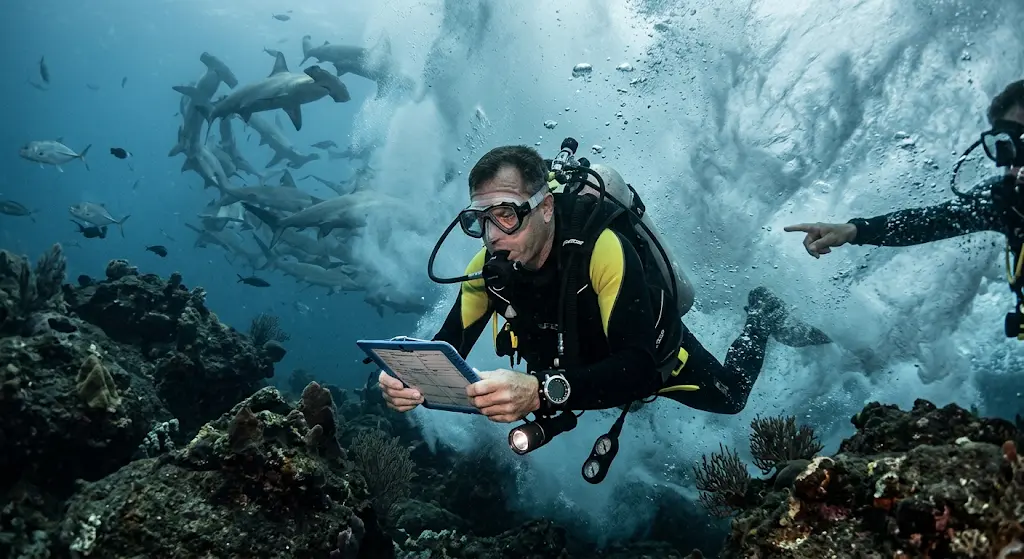
Gordon Rocks is the most demanding day-trip dive site in the central Galápagos and one of the most reliable places in the archipelago to see schooling scalloped hammerhead sharks without joining a liveaboard. The site lies off the northeast coast of Santa Cruz Island, near the Plaza Islands, and is reached on day trips that depart from Santa Cruz.
Local divemasters call it La Lavadora, “the Washing Machine,” a name earned by the strong, shifting currents and surge that move water through the rocks. Conditions can change within minutes, and currents can push divers horizontally, upward or downward depending on the tide and the position inside the crater.
That reputation explains why Gordon Rocks is reserved for experienced divers. The same water movement that makes it challenging also brings nutrients, which attract large pelagic species. Understanding how the site works, what experience operators expect and how to manage the current is the basis of a safe dive here.
| Specification | Detail |
|---|---|
| Location | Off northeast Santa Cruz, near the Plaza Islands |
| Site type | Eroded volcanic crater with exposed and submerged pinnacles |
| Typical depth | 15 to 30 m (about 50 to 100 ft) |
| Experience level | Advanced; operators usually ask for Advanced Open Water and a minimum logged dive count |
| Key species | Scalloped hammerheads, Galápagos sharks, eagle rays, sea turtles, sea lions |
| Water temperature | About 16 to 26 °C, depending on season |
| Visibility | Generally 10 to 20 m; variable with plankton and upwelling |
| Access | Guided day trips from Santa Cruz, usually two dives |
The Collapsed Crater That Creates the Current
Gordon Rocks is the remnant of a volcanic tuff cone, a type of crater formed when rising magma meets seawater and explodes into fine ash that later hardens. Over time, wave erosion broke down much of the rim. What remains is a partial ring of rock with two pinnacles breaking the surface and a third lying just below it, enclosing a crater basin open to the sea.
This shape is the reason for the current. Tidal water flows between the pinnacles and across the crater rim, accelerating through the gaps. When the tide turns, the direction of flow reverses, and eddies form along the walls. The result is the circular, unpredictable movement that gives the site its nickname.
The site sits within the Galápagos Marine Reserve, one of the largest marine protected areas in the world. Its location in the central islands, where cool and warm currents mix, explains the concentration of fish and the regular presence of sharks. It is also close to land-based visitor sites such as those covered in our North Seymour day tour, which lies in the same northern sector of Santa Cruz.
Pinnacles, Walls and Large Pelagic Life
Dives at Gordon Rocks usually follow the outer walls of the pinnacles or the slope inside the crater, at depths between roughly 15 and 30 meters. The most productive area for sharks is often the outer edge, where divers hold position on the rocks and watch the open water.
Scalloped hammerheads are the main attraction, sometimes seen individually and sometimes in groups. Other frequent sightings include Galápagos sharks, whitetip reef sharks, spotted eagle rays, golden cownose rays, marbled rays, green sea turtles and playful Galápagos sea lions. Schools of barracuda, jacks and Pacific creolefish often fill the water column, while moray eels and octopus occupy the crevices.
Less predictable visitors include manta rays and, during the cool season, the ocean sunfish (Mola mola). A broader overview of the species divers and snorkelers may encounter appears in our guide to Galápagos islands animals.
Techniques for Managing Surge and Shifting Flow
Safety at Gordon Rocks depends on technique and discipline more than on courage. Most operators apply a similar set of procedures:
- Negative or rapid descents, with divers dropping quickly to avoid being carried away from the pinnacles at the surface.
- Staying close to the guide and the group at all times, since separation in current is the main risk.
- Holding position low against the rock, using only bare rock surfaces and fingertips, never coral or living organisms.
- Constant air monitoring, because fighting current raises gas consumption significantly.
- Ascending as a group, with a safety stop that may be performed while drifting in blue water.
Every diver should carry a surface marker buoy (SMB) and know how to deploy it from depth, as well as a personal dive computer. Many operators also recommend an audible signaling device. Downcurrents are possible near the walls; the standard response is to move away from the rock and toward open water rather than trying to swim upward against the flow.
Divers who are not yet comfortable with these conditions may prefer a less demanding introduction. Our Kicker Rock day tour off San Cristóbal also offers shark encounters, typically with more manageable conditions.
Water Temperature and Visibility Through the Year
Conditions at Gordon Rocks follow the two Galápagos seasons. From roughly December to May, the warm season brings water temperatures of about 22 to 26 °C, calmer seas and good visibility on many days. A 5 mm wetsuit is usually sufficient.
From roughly June to November, the cool garúa season brings the influence of the Humboldt Current. Water temperatures can fall to around 16 to 21 °C, seas become rougher and plankton levels rise, which can reduce visibility. A 7 mm wetsuit with a hood is advisable. The cooler, nutrient-rich water also tends to increase shark and ray activity, which is why many divers consider this period worthwhile despite the conditions.
Galápagos National Park Rules for Divers
All diving in the Galápagos Marine Reserve must be conducted with operators licensed by the Galápagos National Park Directorate and accompanied by a certified naturalist dive guide. Independent diving is not permitted.
Divers must keep a respectful distance from wildlife, never touch, chase or feed animals, and avoid contact with the seabed. Park rules discourage glove use to prevent touching marine life, so divers should confirm the current policy with their operator. Collecting shells, rocks or any natural material is prohibited, and flash use should be limited around sharks and rays to avoid disturbing them.
Departure Points, Requirements and Essential Gear
Day trips to Gordon Rocks start from Santa Cruz. Depending on the operator, divers either board in Puerto Ayora or are driven across the island to the Itabaca Channel, which shortens the boat ride to the site. Total trip time is usually a full day with two dives, sometimes combining Gordon Rocks with a nearby site.
Operators generally require Advanced Open Water certification or equivalent and a minimum number of logged dives, often with recent experience in current. Divers should bring their certification card and logbook. Recommended equipment includes a properly fitted wetsuit for the season, an SMB, a dive computer and seasickness medication for the boat ride. Travelers who want to understand how Gordon Rocks fits among other excursions on the island can consult our comparison of Galápagos day tours.
For divers deciding between day trips and multi-day itineraries, the trade-offs are explained in our guide to liveaboard versus day diving in Galápagos. Experienced divers who handle Gordon Rocks comfortably are often well prepared for the remote northern sites described in our Darwin and Wolf islands diving guide, which are reached only by liveaboards such as the Humboldt Explorer and the Galápagos Sky.
A Benchmark Site for Galápagos Diving
Gordon Rocks occupies a particular position in Galápagos diving. It is accessible from an inhabited island, yet it delivers the type of pelagic encounters usually associated with remote liveaboard routes. Its geology, a broken volcanic crater exposed to tidal flow, produces both the challenge and the abundance, making it a clear example of how physical oceanography shapes marine biodiversity.
The presence of scalloped hammerheads is especially significant. The species is listed as critically endangered on a global scale, and protected areas such as the Galápagos Marine Reserve are among the few places where it can still be observed in groups. Regular sightings at Gordon Rocks reflect the value of long-term protection and provide data for monitoring programs that track shark populations across the eastern Pacific.
For divers, the site functions as a practical benchmark. Managing its current requires sound buoyancy, air awareness and close teamwork with a guide. Those skills, more than equipment or certification level alone, determine whether a dive here is safe and productive, and they form the foundation for the more exposed sites farther north in the archipelago.
Related Questions About Diving Gordon Rocks
How much experience do I need to dive Gordon Rocks?
Most operators require Advanced Open Water certification or equivalent and a minimum number of logged dives, often with experience in currents. Requirements vary by company, so divers should confirm them when booking and carry their logbook.
Why is Gordon Rocks called the Washing Machine?
The name comes from the strong, changing currents that flow through the gaps of the eroded volcanic crater. Tidal shifts create circular water movement, surge and occasional downcurrents, which can move divers in several directions within a single dive.
How deep is the diving at Gordon Rocks?
Most dives take place between about 15 and 30 meters. Guides adjust the profile to conditions, keeping divers within recreational limits and close to the pinnacles where they can hold position safely.
What is the best time of year to see hammerhead sharks at Gordon Rocks?
Hammerheads can be seen year-round, but the cool season from roughly June to November often brings more shark activity because of nutrient-rich water. The warm season offers calmer seas and warmer water, with sightings still common.
Can beginners or snorkelers visit Gordon Rocks?
No. The site is not suitable for beginner divers or snorkelers because of its currents and surge. Less experienced divers usually start at calmer sites near Santa Cruz or San Cristóbal before attempting Gordon Rocks.
What wetsuit thickness is recommended for Gordon Rocks?
A 5 mm wetsuit is generally adequate in the warm season, when water reaches 22 to 26 °C. In the cool season, when temperatures can drop to around 16 °C, a 7 mm wetsuit with a hood provides better protection.