
Every visitor who plans a multi-day voyage through the Galápagos eventually faces the same structural decision. Either book individual cabins on a scheduled departure and share the vessel with other travelers, known in the industry as a group joiner cruise, or reserve the entire boat for a single party through a private charter. Both formats use the same fleet of licensed yachts, catamarans, and liveaboards, and both visit the same protected sites.
The differences lie elsewhere. They affect how much a trip costs per person, who travelers spend eight days with in close quarters, how meals and daily pacing are organized, and how far in advance the booking must be secured. What they do not change is the itinerary framework itself, which is set by the Galápagos National Park Directorate (GNPD) and applies to every vessel regardless of who is on board.
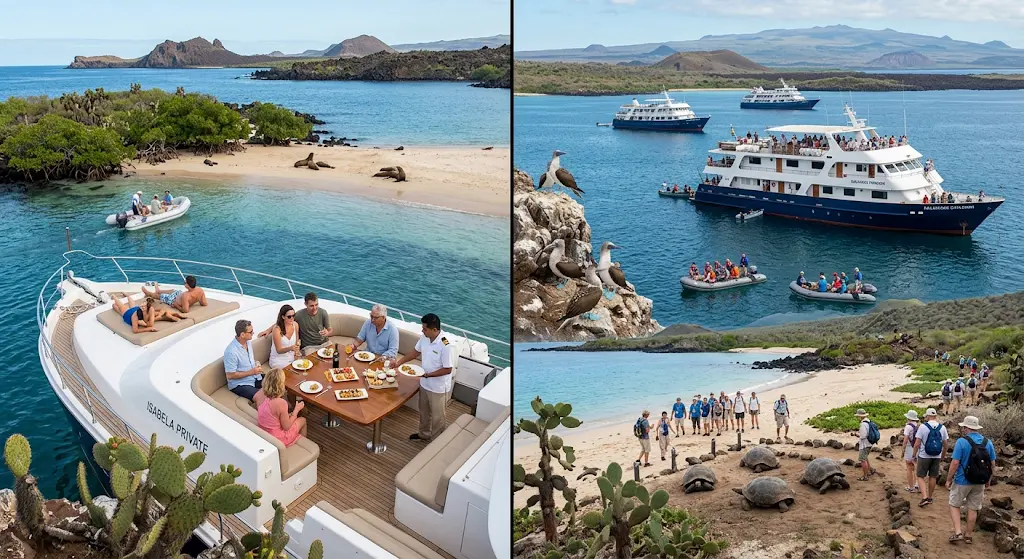
Understanding where real flexibility exists, and where it does not, is the key to choosing well. The sections below explain how each format works within the archipelago’s regulatory system, how pricing is calculated, how the choice plays out on diving liveaboards, and which travel profiles each option serves best.
| Factor | Group Joiner Cruise | Private Charter |
|---|---|---|
| Booking unit | Individual berth or cabin | Entire vessel for one departure |
| Itinerary | Fixed, GNPD-approved route | Same fixed route; choice of departure and itinerary option |
| Typical vessel capacity | 8 to 16 guests on most yachts and catamarans | 8 to 16 guests, all from one party |
| Daily schedule | Set by crew and guide | Meal times and pacing adjustable within park slots |
| Solo travelers | Cabin share or single supplement | Not applicable |
| Recommended lead time | 4 to 12 months | 12 to 18 months for peak dates |
| Best suited for | Couples, solo travelers, small families | Multigenerational families, friend groups, dive clubs, photographers |
Why Every Galápagos Cruise Follows a Fixed Itinerary
The Galápagos Islands sit roughly 1,000 kilometers off the coast of Ecuador and are protected both on land, by the national park that covers about 97 percent of the archipelago’s terrestrial area, and at sea, by the Galápagos Marine Reserve. To prevent overcrowding at fragile visitor sites, the GNPD assigns each licensed vessel a set of approved itineraries, typically structured in 15-day cycles. Visiting times at each landing are allocated in advance so that groups from different boats rarely overlap.
This system has a direct consequence for anyone considering a charter. Paying for an entire yacht does not grant permission to design a custom route, add an unscheduled island, or extend time at a favorite site. The itinerary belongs to the vessel’s permit, not to the client. What a charter party can do is select the departure date and, on boats that operate several itineraries, choose the route that best matches its interests, whether that means the western islands of Isabela and Fernandina or the southern circuit through Española and Floreana.
How a Group Joiner Departure Works
A joiner cruise is the standard format across the fleet. Travelers reserve one or more cabins on a scheduled departure listed by the operator, and the remaining berths are sold to other parties. On a typical 16-passenger vessel, that may mean six or seven separate groups from different countries sharing dining tables, panga rides, and shore excursions.
The format has practical advantages. It allows couples and solo travelers to access the full range of vessel categories without carrying the cost of empty berths, and it offers the widest choice of dates across the season. Many travelers also value the social dimension of sharing a voyage with people who have similar interests. The trade-off is less control over group dynamics, a fixed daily rhythm, and the possibility that fitness levels, ages, and expectations vary widely among guests. For an overview of vessels operating this format, the Galápagos naturalist cruise fleet lists yachts and catamarans by category.
What a Private Charter Changes and What It Cannot
Within the fixed itinerary, a charter offers a meaningful degree of control. Wake-up times, meal schedules, menu preferences, and the balance between active and quiet periods can be negotiated with the crew. The naturalist guide can tailor interpretation to the group, focusing on photography, geology, birdlife, or children’s learning as needed. Families traveling with young children or older relatives benefit in particular, since the pace of each excursion can follow the slowest member of the party without affecting strangers.
Certain limits remain firm. Landing times are still assigned by the park, group size ashore is capped at 16 visitors per naturalist guide, and trail rules apply without exception. A charter is therefore best understood as control over the experience on board and the tone of excursions, not over where the vessel goes or how long it stays.
Cost Logic Behind Cabins and Full-Boat Bookings
Joiner fares are quoted per person, usually based on double occupancy, and vary by vessel category, from tourist class to luxury. Single supplements commonly add 50 to 100 percent to the cabin rate, although some operators offer same-gender cabin sharing to avoid the surcharge.
Charter rates are generally calculated as the value of all berths on the vessel for the full departure, sometimes with a modest reduction. As a result, a charter is only cost-efficient when the party fills most of the boat. A group of 14 on a 16-berth catamaran will pay roughly what it would pay for individual cabins, while gaining exclusivity. A group of six on the same vessel will pay for ten empty berths. Park entrance fees, the Transit Control Card, domestic flights, and gratuities are typically charged separately in both formats. A detailed breakdown by category is available in the guide to Galápagos naturalist cruise costs.
Charters and Joiner Trips on Diving Liveaboards
The same choice exists on dedicated dive vessels, where it carries additional weight. Most Galápagos liveaboards accommodate around 16 divers, and their routes concentrate on the remote northern islands of Darwin and Wolf, which can only be reached by liveaboard. Strong currents, negative entries, and deep drift profiles make diver experience and group cohesion especially important.
For this reason, dive clubs and experienced buddy groups frequently charter entire vessels such as the Galápagos Aggressor III, the Humboldt Explorer, or the Galápagos Sky. A chartered dive group shares a known skill level and can align dive briefings, equipment, and photography priorities. Individual divers, on the other hand, usually join scheduled departures, which remain the most accessible route to sites like Darwin’s Arch area and the hammerhead aggregations described in the Darwin and Wolf diving guide. Travelers still weighing whether a liveaboard is necessary at all can compare formats in liveaboard versus day diving.
Seasonal Timing and Booking Windows
The archipelago has two broad seasons. From December to May, the warm season brings calmer seas, water temperatures of roughly 24 to 28°C, and better surface visibility. From June to November, the cooler garúa season brings nutrient-rich upwelling, water between about 19 and 23°C, rougher crossings, and peak activity among seabirds and marine life. On dive vessels, the cool months coincide with the highest likelihood of whale shark encounters at Darwin and Wolf.
Timing affects the two formats differently. Joiner cabins remain available across most months, though popular vessels sell out early. Charters require an entire departure to be free, which is rare during Christmas, Easter, and July to August. Groups planning for those periods generally reserve 12 to 18 months ahead.
Park Rules Apply Equally to Both Formats
Whether the vessel carries one family or several unrelated parties, park regulations do not change. Visitors must remain on marked trails, stay at least two meters from wildlife, avoid flash photography of animals, and never feed or touch them. Every shore visit requires a certified naturalist guide, and drones, food, and single-use plastics are restricted at visitor sites. Biosecurity inspections at entry points apply to all luggage. These measures are central to why the Galápagos retains wildlife that shows little fear of people.
Matching the Format to the Traveler
A joiner cruise is the logical choice for most couples, solo travelers, and small families, offering broad date availability and access to every vessel category at per-person rates. A charter becomes compelling when a group can fill most of the berths, when travelers include young children or people with mobility considerations, or when a shared purpose, such as wildlife photography or technical diving, benefits from a uniform pace. In practical terms, departures from both formats fly in through Baltra or San Cristóbal, include all meals and guided excursions on board, and require the same essential gear, from reef-safe sunscreen and sturdy footwear for lava terrain to a wetsuit for cooler months.
The Broader Picture
The private charter versus group joiner question is often framed as a matter of luxury or budget. In the Galápagos, the more accurate framing is control over social and operational variables within a system that is deliberately rigid. Because the GNPD regulates routes, landing times, and group sizes for every vessel, the ecological footprint of a chartered yacht and a shared departure is essentially identical.
That rigidity is the archipelago’s most important management tool. Fixed itineraries distribute visitor pressure across sites, allow habitats time to recover, and keep encounters with wildlife predictable and low-impact. Travelers who understand this tend to make better decisions, focusing on vessel quality, itinerary content, and group composition rather than on promises of exclusivity that the park does not permit.
For most visitors, the deciding factors will be group size, travel companions, and timing. A full charter delivers a cohesive, self-paced experience when the numbers support it, while joiner departures remain the most efficient and flexible way to reach the same protected islands. In both cases, the experience is shaped primarily by the itinerary and the guide, which remain the core of any voyage through the Galápagos.
FAQ About Private Charters and Group Joiner Cruises in the Galápagos
Can a private charter change the islands visited on a Galápagos cruise?
No. Every licensed vessel follows itineraries approved by the Galápagos National Park Directorate. A charter party can choose the departure date and, on vessels with several routes, select which approved itinerary to follow, but it cannot add, remove, or substitute visitor sites.
How many people are needed to make a Galápagos charter worthwhile?
Charter prices are usually based on the full berth capacity of the vessel. For most yachts and catamarans carrying 12 to 16 guests, a charter becomes cost-efficient when the group fills at least three quarters of the available berths.
Are group joiner cruises suitable for solo travelers?
Yes. Joiner departures are the standard option for solo travelers. Operators either charge a single supplement for a private cabin or offer cabin sharing with another traveler of the same gender, which avoids the extra cost.
Is the group size on shore excursions different on a charter?
The park limits groups to a maximum of 16 visitors per naturalist guide on both formats. On a charter, the entire group consists of the same party, which allows the guide to adapt pace and interpretation to everyone present.
Can divers charter a liveaboard to Darwin and Wolf?
Yes. Dive clubs and private groups regularly charter entire liveaboards for Darwin and Wolf itineraries. Individual divers can book berths on scheduled departures. In both cases, operators typically require advanced certification and logged experience in strong currents.
How far in advance should a Galápagos charter be booked?
For peak periods such as Christmas, Easter, and July to August, charters are commonly reserved 12 to 18 months in advance. Outside those windows, six to twelve months may be enough, depending on the vessel.