Diving in the Galápagos operates under a two-tier system that has little to do with comfort preferences and everything to do with regulation. A small licensed fleet of dive liveaboards holds permission to visit Darwin and Wolf, the two remote northern islands where hammerhead aggregations and seasonal whale sharks concentrate. Everyone else dives from a port, on a day boat, at sites within a few hours of Santa Cruz, San Cristóbal or Isabela.
That legal boundary drives every other difference between the formats: total number of dives, water temperature, current strength, minimum certification, and a price gap that typically runs from a few hundred dollars to well over five thousand. Divers who treat the choice as a budget question alone often end up in the wrong format, either paying liveaboard rates for conditions they cannot handle or booking day trips expecting encounters that only occur 160 kilometres to the north.
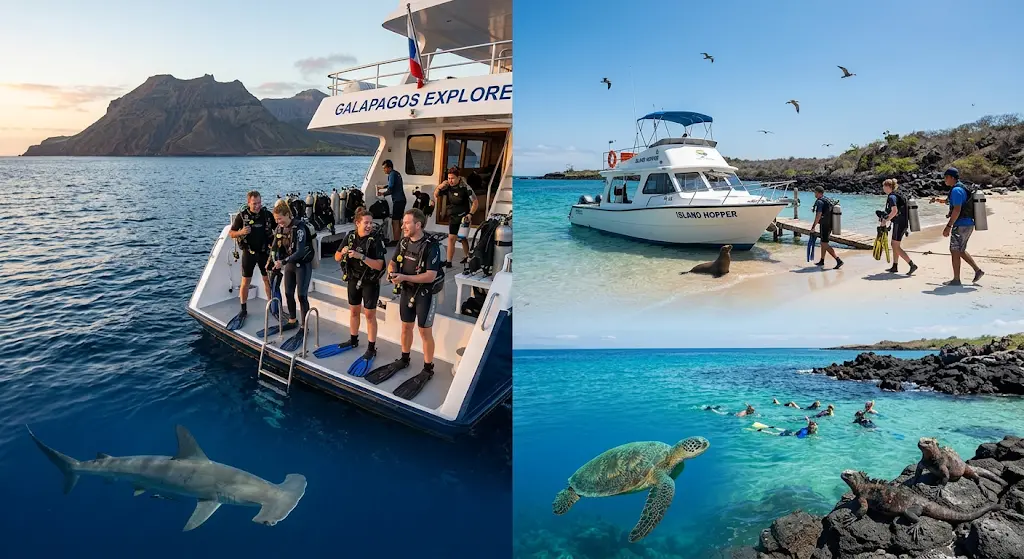
This comparison sets out what each option actually delivers in measurable terms, which sites each one reaches, what experience level the operators require, and how seasonality changes the calculation. The aim is a decision based on logged dives, currents and access rights rather than marketing language.
| Criterion | Liveaboard | Day Diving |
|---|---|---|
| Typical duration | 7 nights / 8 days | Single day, repeatable |
| Dives per trip | Roughly 17 to 20 | 2 per day, 3 on some Isabela trips |
| Darwin and Wolf access | Yes, licensed vessels only | Not permitted |
| Certification usually required | Advanced plus 50 to 100 logged dives | Open Water for easy sites, Advanced for Gordon Rocks |
| Indicative price | Approx. US$5,000 to US$8,000 per person | Approx. US$180 to US$300 per two tank day |
| Water temperature range | 16 to 27 °C depending on site and season | 18 to 26 °C |
| Exposure protection | 7 mm plus hood, gloves recommended | 5 to 7 mm, hood in cool season |
| Non diving companions | Poorly suited | Easily accommodated |
| Mandatory fees | National Park entry plus INGALA transit card | Same, paid once on arrival |
Why the Northern Islands Are Off Limits to Port Based Boats
Darwin and Wolf sit roughly 160 to 200 kilometres northwest of the central archipelago, an overnight passage of about 12 to 14 hours from Isabela or Santa Cruz. No day boat can reach them and return within legal operating hours, and the Galápagos National Park restricts the northern route to a limited number of permitted dive liveaboards. The fleet is small, which is why itineraries sell out 9 to 12 months ahead in peak months.
The ecological reason for the concentration of large animals there is oceanographic. Both islands are eroded volcanic remnants standing in the path of the Cromwell and Panama currents, where upwelling delivers cold, nutrient rich water to steep walls and plateaus. The result is dense schooling behaviour among scalloped hammerheads, along with Galápagos sharks, silky sharks, eagle rays and, between June and November, migrating whale sharks, most of them large pregnant females. Darwin’s Arch collapsed in May 2021 and the remaining pillars are now known as the Pillars of Evolution, but the dive site itself, the plateau and its current lines, is unchanged.
What Central Island Day Diving Actually Delivers
Port based diving covers a genuinely strong set of sites and is often undersold. From Puerto Ayora, operators run to Gordon Rocks, an eroded tuff cone crater with reliable hammerhead sightings and strong washing machine currents, plus Seymour Channel, Mosquera, Daphne Minor and Punta Carrión for calmer conditions. From San Cristóbal, the main target is Kicker Rock (León Dormido), a vertical tuff formation split by a channel that funnels sharks and rays, described in detail in our Kicker Rock day tour guide.
Isabela adds Cuatro Hermanos and Tortuga Island, while Santa Cruz operators also run to Pinzón and Cousins Rock, a site favoured for seahorses, black coral and frequent sea lion interaction. Divers weighing sites against one another may find our Kicker Rock and Pinzón comparison useful, since the same contrast in current and topography applies below the surface.
What day diving does not offer is volume. Two dives per day, with a surface interval spent on a small boat, produces around 10 to 12 dives in a week of diving, compared with 17 to 20 aboard a liveaboard. Repeated exposure matters in the Galápagos because encounters are probabilistic. More dives on a current swept plateau simply means more chances.
Currents, Cold Water and the Experience Threshold
Conditions in the archipelago are demanding by tropical standards, and the two formats sit at different points on that scale. Northern itineraries involve negative entries, descents into moving water, reef hook use on the plateau, and surface pickups sometimes several hundred metres from the drop point. Operators of vessels such as the Galápagos Sky and the Humboldt Explorer typically require Advanced Open Water certification plus a documented dive count in the range of 50 to 100, and many ask for recent cold water or current experience.
Thermal load is the second filter. Cold upwelling can drop temperatures to 16 to 18 °C at central sites during the cool season, while northern waters near Darwin often run warmer at 24 to 27 °C in the same months. That inversion surprises divers who pack for the tropics. A 7 mm suit with hood is standard practice on liveaboards including the Galápagos Master and the Tiburón Explorer, and remains sensible for day diving at Gordon Rocks. Nitrox, widely available on liveaboards, meaningfully extends bottom time across a four dive day.
Seasonal Patterns That Should Influence the Booking Month
The archipelago runs two hydrographic seasons rather than a wet and dry cycle in the usual sense. From June to November, the Humboldt influence brings cooler, more nutrient rich and often greener water, stronger surge and the whale shark window in the north. From December to May, seas calm, visibility improves to 15 to 25 metres at many sites, and water warms to 24 to 28 °C, which suits less experienced divers and anyone combining diving with island tours.
Visibility is variable in both seasons and is generally poorer where plankton density is highest, which is precisely where large animals feed. Divers should expect a trade off between clarity and biomass rather than treating low visibility as a failed day. Travellers combining diving with land itineraries can cross reference conditions in our comparison of Galápagos day tours.
Park Rules, Safety Margins and Practical Constraints
All diving occurs inside the Galápagos Marine Reserve, under National Park regulation. Certified naturalist or dive guides accompany every group, group sizes are capped, and touching, feeding or chasing marine life is prohibited. Gloves are restricted at some sites to discourage contact with the substrate. Every visitor pays the National Park entrance fee and the INGALA transit control card on arrival, regardless of format.
Two operational rules deserve planning attention. A hyperbaric chamber operates in Puerto Ayora, and evacuation from remote northern sites takes time, which is why conservative profiles and dive computers are standard. Second, no diving is permitted within 24 hours of a flight, so the final day of any itinerary is a surface day. Anyone considering a broader survey of vessel classes, cabin configurations and route options can review the full Galápagos dive liveaboard fleet.
Matching the Format to the Diver
The decision resolves cleanly in most cases. Divers with fewer than 50 logged dives, limited cold water experience, non diving travel companions, or a budget under roughly US$2,000 for the diving component are better served by port based day diving, ideally spread across two islands to vary the site profile. The format also allows land excursions, highland tours and beach time between dive days.
Experienced divers whose primary objective is large pelagic species, particularly hammerhead schools and whale sharks, gain access to something the day boats legally cannot offer. For that specific goal, the liveaboard is not a luxury upgrade of the same product. It is a different product with a different permit.
Final Thoughts
The Galápagos remains one of the few marine environments where diving quality is determined less by reef health than by ocean physics. Three major currents converge on the archipelago, producing thermal boundaries that concentrate plankton, fish and apex predators in predictable places at predictable times. The northern islands are simply where that convergence is strongest, and the permit system exists to keep pressure on those aggregation sites within measurable limits.
That regulatory design has consequences for divers. Access is rationed rather than sold freely, which raises cost and lead time but has also kept encounter rates high in an era when shark populations have declined sharply across most of the tropical Pacific. The Hermandad Reserve, established in 2022 along the migratory corridor toward Cocos Island, extends the same logic to the routes these animals use between archipelagos.
For the individual traveller, the practical conclusion is to be honest about logged dives and cold water tolerance before booking. The archipelago rewards competence and punishes overreach. A well chosen sequence of day dives at Gordon Rocks and Kicker Rock will produce a better week than an oversubscribed northern itinerary undertaken without the current handling skills those sites demand, and the option to return later, better prepared, always remains open.
FAQ About Diving in the Galápagos
Can I dive Darwin and Wolf on a day trip?
No. Both islands lie roughly 12 to 14 hours of navigation north of the central archipelago, and the National Park authorises the route only for a limited fleet of licensed dive liveaboards. Day operators from Santa Cruz, San Cristóbal and Isabela are restricted to central and southern sites.
How many logged dives do liveaboard operators require?
Most require Advanced Open Water certification and a documented dive count between 50 and 100, with several asking for recent experience in cold water and strong currents. Some vessels raise the threshold for northern itineraries and may request a dive log or referral from a recent instructor.
What wetsuit thickness is appropriate?
A 7 mm suit with hood is the practical standard from June to November, when upwelling can drop central island temperatures to around 16 to 18 °C. From December to May, a 5 mm suit is usually sufficient at central sites, though a hood remains useful on deeper profiles.
Is Gordon Rocks suitable for newly certified divers?
Generally no. The site sits in an eroded crater where tidal exchange produces strong, shifting currents and downcurrents. Reputable operators require Advanced Open Water certification and a reasonable number of logged dives, and will decline bookings from divers without current experience.
How long before flying must I stop diving?
Standard practice is a minimum of 24 hours between the last dive and any flight, including inter island flights. Liveaboard itineraries build this into the schedule, ending diving on the penultimate day, and day dive operators will refuse bookings that conflict with a departure.
Which season offers the best visibility?
December to May generally delivers clearer water, calmer seas and warmer temperatures, with visibility often between 15 and 25 metres. The cooler months from June to November bring more plankton and reduced clarity, but also higher densities of large marine life, including the whale shark season in the north.