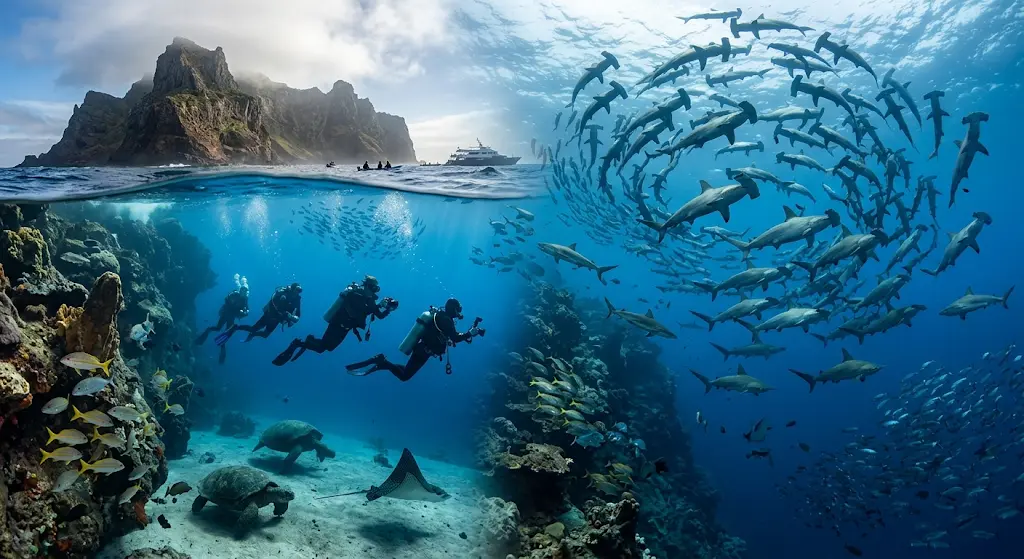
Darwin and Wolf lie roughly 100 nautical miles northwest of the main Galápagos group, separated from Isabela and Fernandina by an open stretch of Pacific that takes most vessels between 14 and 16 hours to cross. Neither island permits landings. There are no trails, no visitor sites and no day tours — the only lawful way to experience them is underwater, from a liveaboard dive vessel operating on a permitted northern itinerary.
What justifies the distance is measurable rather than anecdotal. A 2016 study published in PeerJ recorded the highest reef fish biomass documented anywhere on the planet at these two islands, with sharks accounting for roughly three-quarters of it. Scalloped hammerheads school here in the hundreds, Galápagos sharks patrol the drop-offs year-round, and between June and November the plateaus draw a steady procession of whale sharks, the overwhelming majority of them large, apparently pregnant females — a demographic pattern found at almost no other aggregation site worldwide.
The trade-off is access and difficulty. Northern itineraries are restricted to a limited number of licensed vessels, sell out months ahead, and impose experience minimums that exclude newly certified divers. Conditions involve strong, shifting currents, negative entries, surge along the walls and open-ocean pickups. This guide covers the geology, the dive sites, the seasonal cycle, the regulatory framework and the practical requirements for booking a Darwin and Wolf expedition.
| Specification / Metric | Detail / Value |
|---|---|
| Location | Northern Galápagos; approx. 100 nautical miles (185 km) northwest of the central islands |
| Access | Liveaboard dive vessels only — no day tours, no land visits |
| Crossing time from central islands | 14–16 hours, usually overnight |
| Typical itinerary length | 7 or 8 days / 6–7 diving days |
| Dives per day | 3–4, including repeated dives at the same site |
| Certification required | Advanced Open Water or equivalent; most operators require 50–100 logged dives |
| Water temperature | 73–82°F / 23–28°C (Dec–May); 69–77°F / 21–25°C (Jun–Nov), with sharp thermoclines |
| Exposure protection | 5 mm minimum; 7 mm with hood recommended in the cool season |
| Typical depth range | 50–100 ft / 15–30 m |
| Whale shark season | June to November, peaking August–October |
| Key species | Scalloped hammerheads, whale sharks, Galápagos sharks, silky sharks, eagle rays, dolphins, green turtles |
| Protection status | Darwin and Wolf Marine Sanctuary (no-take, established 2016); Hermandad Marine Reserve added 2022 |
Two Eroded Volcanic Remnants on a Submarine Ridge
Darwin and Wolf are the oldest exposed land in the archipelago, remnants of shield volcanoes that formed several million years ago over the Galápagos hotspot and have since drifted northeast along the Nazca Plate. Wave action has stripped them down to steep tuff and basalt walls — Wolf rises to around 830 feet and covers barely half a square mile; Darwin is smaller and lower still. Both sit on a submarine ridge that rises abruptly from deep water, and it is this bathymetry, not the islands themselves, that generates the diving.
Steep topography forces deep, nutrient-rich water upward as currents strike the ridge. The resulting upwelling concentrates plankton and small schooling fish, which draw predators in numbers that shallow, gently sloping reefs cannot sustain. The islands function as a cleaning and aggregation station within a much larger migratory corridor linking Galápagos to Cocos Island in Costa Rica and Malpelo in Colombia — a route that satellite tagging has confirmed hammerheads and whale sharks use repeatedly.
Darwin’s Arch, the natural rock bridge that appeared in nearly every photograph of the site, collapsed in May 2021 through ordinary erosion. The two remaining columns are now officially called the Pillars of Evolution. The dive site itself, a submerged plateau running southeast from the pillars, was unaffected.
El Arenal, The Landslide and the Sites That Define the Itinerary
Darwin’s plateau (El Arenal) is the anchor dive of any northern trip. Divers descend to a rocky shelf at roughly 50 to 65 feet, settle behind boulders out of the current, and observe hammerhead schools moving along the reef edge. The theatre of the dive is horizontal rather than vertical: the wall drops away into blue water and the action happens at its margin. Whale sharks pass along this same boundary during the cool season, typically cruising fast in open water rather than lingering.
Wolf offers more variety across several sites. The Landslide (El Derrumbe) is a boulder-strewn slope with cleaning stations frequented by hammerheads; Shark Bay and The Pinnacle hold Galápagos sharks and dense fish schools; The Caves and La Banana add swim-throughs and structure. Because Wolf’s sites face different directions, guides can select according to current and swell on the day, which makes it the more dependable of the two islands when conditions deteriorate.
Both islands are dived repeatedly — commonly four times a day at the same site — because encounters vary hour to hour with tide and current. Silky sharks often gather beneath the vessel at night, and dolphin pods, Mobula rays and, in the cool season, the occasional Mola mola appear without pattern. The archipelago’s broader endemic and marine wildlife is well documented elsewhere; what distinguishes the far north is the concentration of large pelagics rather than endemism.
Current, Surge and Why Reef Hooks Are Not an Option
Diving here is technically demanding in specific, predictable ways. Negative entries are standard: divers roll backward and descend immediately to avoid being displaced at the surface. Currents commonly run one to three knots and can shift direction mid-dive, and downcurrents along the walls require immediate lateral movement away from the reef rather than attempts to swim upward.
Unlike some Pacific shark sites, reef hooks are not permitted in the Galápagos Marine Reserve. Divers hold position by wedging behind rock or by finning, which raises air consumption considerably. Nitrox is strongly recommended and available on most vessels, as is a surface marker buoy — mandatory at these sites — and many operators require a personal GPS or satellite locator beacon given the exposure of open-ocean pickups.
Visibility ranges widely, from 50 feet during heavy plankton blooms to over 100 feet in the warm season. Counterintuitively, the reduced clarity of the cool months coincides with the strongest animal activity.
Cool-Season Upwelling Versus Warm-Season Clarity
The archipelago runs on two hydrographic regimes, and the far north responds sharply to both. From June through November, the Humboldt Current cools the water and drives upwelling; thermoclines are pronounced, surge increases, and whale shark sightings peak between August and October. This is the season most experienced divers target, accepting colder water and rougher crossings for the encounters it delivers. The same cool-season productivity affects the whole archipelago, including the likelihood of cetacean sightings in September.
From December through May, warmer Panama Current water raises temperatures, calms the crossings and improves visibility. Hammerhead schools remain present year-round and can be exceptionally dense in these months, but whale shark encounters become sporadic. Manta rays and eagle rays are more frequently reported during the warm season.
A No-Take Sanctuary Inside an Expanded Reserve
In 2016 Ecuador designated approximately 15,000 square miles around Darwin and Wolf as a fully protected no-take sanctuary, prohibiting all extractive fishing. In January 2022 the government created the Hermandad Marine Reserve, adding roughly 23,000 square miles to the north and northeast to reinforce the migratory corridor toward Cocos Island.
Operational rules are enforced by the Galápagos National Park and by vessel guides. Land access is prohibited without research authorisation. Divers must not touch, chase or attempt to ride marine life; positioning above or ahead of whale sharks is discouraged because it interrupts their movement. Contact with the reef is limited to bare rock, and vessels must hold a specific northern itinerary permit — a general Galápagos cruise licence does not include Darwin and Wolf.
Vessels, Certification Thresholds and What to Pack
Northern itineraries are served by a small fleet of purpose-built dive vessels. Larger, more stable platforms such as the Galapagos Sky and the Humboldt Explorer handle the open crossing comfortably, while the Galapagos Master and the Galapagos Aggressor III are long-established options on the same route. Smaller-group alternatives include the