
A Galápagos naturalist cruise is priced per person, per night, in a market where the number of vessels is capped by law. That single regulatory fact explains most of what confuses first time buyers. There are roughly 60 to 70 authorised passenger boats in the archipelago, itineraries are approved by the National Park rather than designed freely by operators, and supply cannot expand when demand rises. Prices therefore behave less like resort rates and more like a rationed commodity.
Galápagos Naturalist Cruise Costs: What You Pay, and What the Price Excludes
Advertised figures also cover different things depending on the operator. A quoted cruise fare typically includes the cabin, all meals, guiding by a certified naturalist, and shore excursions, but excludes the National Park entrance fee, the INGALA transit control card, flights from mainland Ecuador, alcohol, wetsuit rental, gratuities and, on some boats, snorkelling equipment. Those exclusions routinely add 700 to 1,200 US dollars per person to a headline price.
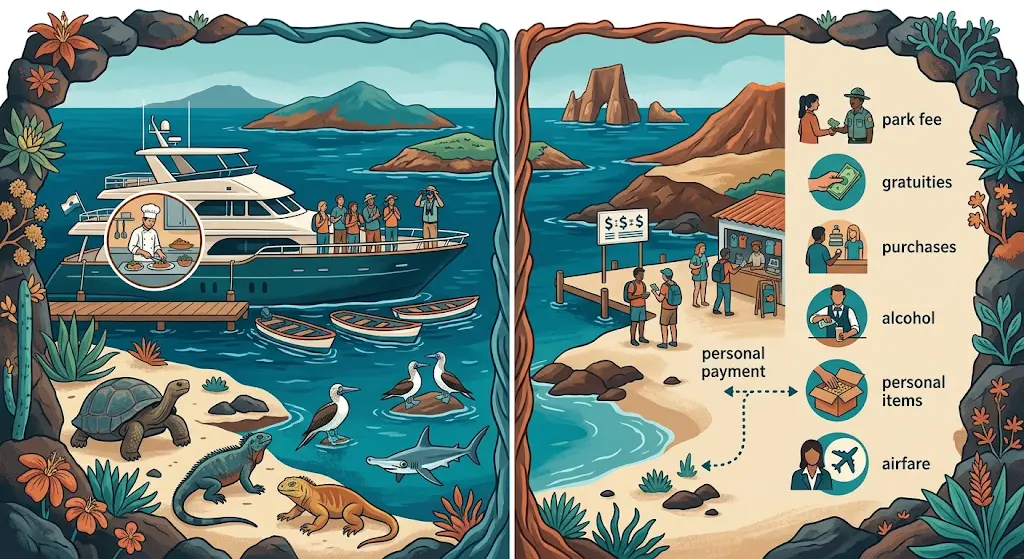
This breakdown sets out the cost structure by vessel category, quantifies the mandatory and optional add ons, and explains the seasonal and structural factors that move rates. The objective is an accurate landed cost per traveller rather than a comparison of brochure numbers.
| Cost Component | Typical Range (per person) | Notes |
|---|---|---|
| Tourist superior class | US$300 to US$450 per night | Smaller yachts, 16 passengers, shared bathrooms on some vessels |
| First class | US$450 to US$650 per night | Catamarans and yachts, private facilities, air conditioning |
| Luxury class | US$700 to US$1,200 per night | Larger cabins, jacuzzi, kayaks, higher guide ratio |
| National Park entrance fee | US$200 adults, US$100 under 12 | Foreign visitors; increased in August 2024, cash on arrival |
| INGALA transit card | US$20 | Purchased at Quito or Guayaquil airport before departure |
| Return flight from mainland | US$350 to US$600 | Quito or Guayaquil to Baltra or San Cristóbal |
| Gratuities | US$150 to US$400 per week | Split between crew and naturalist guide |
| Wetsuit rental | US$40 to US$80 per week | Often free on luxury vessels, charged on smaller boats |
| Single supplement | 50% to 100% of cabin rate | Waived on some departures with cabin sharing |
Why the Fleet Cap Sets the Floor on Pricing
The archipelago has operated under a fixed capacity model since the National Park introduced permanent cupos, or operating permits, tied to individual vessels. A new boat can only enter service by replacing an existing permit, which is why the fleet size has stayed broadly stable for decades while global demand has grown. Itineraries are also assigned by the Park on a rotation designed to spread pressure across visitor sites, meaning two vessels rarely land at the same place at the same hour.
Operating costs compound the effect. Fuel, fresh water, provisions and spare parts all arrive by cargo ship from Guayaquil, crew are paid at Galápagos rates, and every vessel carries at least one certified naturalist guide licensed by the Park. Those inputs are largely fixed regardless of cabin category, which is why even entry level yachts such as the Golondrina or the Yolita II sit well above what a comparable boat would charge elsewhere in Latin America.
What Separates a 350 Dollar Night From a 900 Dollar Night
All vessels visit the same regulated sites with the same guiding standards, so the price ladder reflects the ship rather than the wildlife. The main variables are cabin size and window type, stability, speed, and the ratio of crew and guides to passengers.
Tourist superior yachts are typically 16 passenger monohulls, functional and often excellent value, though they roll more on open crossings and may have smaller cabins with limited storage. First class catamarans such as the Archipel I or the Seaman Journey add a twin hull configuration that reduces roll, private balconies on some cabins, and generally newer equipment. Luxury vessels including the Petrel and the Ocean Spray add suite level cabins, higher speed for longer overnight repositioning, and inclusive extras such as wetsuits, kayaks and paddleboards.
Speed matters more than it appears on a specification sheet. Faster hulls cover more distance overnight, which allows itineraries to reach western Isabela and Fernandina without sacrificing daylight excursion time. Slower vessels tend to concentrate on central island routes.
Itinerary Length and the Cost per Excursion
Most itineraries run 4, 5, 8 or 15 days, with 8 day options offering the best ratio of value to coverage. A 4 day itinerary loses roughly half a day to arrival and departure logistics, so the effective excursion time is closer to two and a half days. Travellers weighing a short cruise against staying in port should compare it directly with our comparison of Galápagos day tours, since a week of day trips from Santa Cruz typically lands between 1,200 and 1,800 dollars including accommodation.
Divers face a separate market. Dive liveaboards carry higher nightly rates because they hold permits for Darwin and Wolf, and the two products are not directly comparable, a distinction covered in our analysis of liveaboard versus day diving.
Seasonal Pricing and Booking Windows
Rates rise in the two high demand windows, mid June to early September and mid December to mid January, when many vessels charge 10 to 20 percent above their base rate and rarely discount. The low periods, roughly late April to early June and September to early November, produce the most last minute availability and the largest reductions, sometimes 25 to 35 percent on unsold cabins.
Conditions differ rather than deteriorate. The cool season from June to November brings choppier seas, cooler water and dense marine activity, while December to May offers calmer crossings, warmer water and better underwater visibility. Neither is objectively superior for wildlife, since the archipelago has no dormant season, as our overview of Galápagos wildlife outlines by species and month.
Fees, Rules and the Costs Travellers Forget
Two payments are unavoidable. The National Park entrance fee stands at 200 US dollars for foreign adults following the 2024 increase, payable in cash on arrival at Baltra or San Cristóbal, and the INGALA transit control card costs 20 dollars and must be bought at the mainland airport before boarding. Neither is included in cruise fares.
Beyond that, budget for gratuities, which most operators suggest at 150 to 400 dollars per person per week, and for onboard drinks, which are rarely inclusive below luxury class. Wi Fi is either unavailable or charged, and coverage at sea remains unreliable. Park rules also shape spending indirectly: visitor groups are capped at 16 per guide, staying on marked trails is mandatory, and there are no shops at visitor sites, so anything forgotten must be bought in Puerto Ayora at import inflated prices. Sturdy footwear, reef safe sunscreen and a dry bag are worth packing rather than purchasing locally.
Final Thoughts
The Galápagos cruise market is one of the few in global tourism where price is set primarily by conservation policy rather than competition. Permit caps, fixed itineraries and guide licensing exist to distribute roughly 270,000 annual visitors across a network of controlled landing sites without concentrating impact. The result is a structurally expensive product that has, by most ecological measures, held visitor pressure within manageable limits for half a century.
That framework also explains why the cheapest and most expensive vessels deliver a similar biological experience. Wildlife encounters are governed by site allocation and guide competence, not cabin category. What additional spending buys is stability, speed, cabin comfort and range, all of which matter on longer western itineraries but none of which change what a traveller sees at Punta Suárez or Genovesa.
For prospective visitors, the practical conclusion is to budget the full landed cost rather than the advertised fare, and to weigh itinerary coverage before vessel class. An 8 day route on a well run first class catamaran generally produces more value than a 4 day luxury departure at the same total price. The archipelago rewards time spent in the water and on the trails, and that resource is bought in days, not in square metres of cabin.
Frequently Asked Questions About Galápagos Cruise Costs
What is a realistic total budget for a week long Galápagos cruise?
For a first class vessel on an 8 day itinerary, expect roughly 3,500 to 5,000 dollars for the cruise itself, plus 220 dollars in mandatory fees, 350 to 600 dollars for flights from the mainland, and 150 to 400 dollars in gratuities. A realistic all inclusive total lands between 4,500 and 6,500 dollars per person.
Is the National Park entrance fee included in cruise prices?
No. The 200 dollar fee for foreign adults is collected separately on arrival at Baltra or San Cristóbal airport and is normally payable in cash. Children under 12 pay 100 dollars. Operators list it as an exclusion because the Park administers the collection directly.
Do last minute bookings save money?
Sometimes, particularly in the low demand months of May, September and October, when operators discount unsold cabins by 25 to 35 percent. The strategy requires flexibility on vessel and dates, and carries real risk in June to August and over the December holidays, when most boats sail full.
Why do single travellers pay so much more?
Cabins are priced per berth, and an unfilled second berth represents lost revenue on a fixed capacity vessel. Supplements typically run between 50 and 100 percent of the cabin rate, though several operators waive them on selected departures or offer to pair solo travellers of the same gender.
Are snorkelling equipment and wetsuits included?
Masks, snorkels and fins are usually provided. Wetsuits are commonly rented for 40 to 80 dollars per week on tourist and first class vessels, while most luxury boats include them. Water temperatures drop to around 18 to 20 degrees Celsius in the cool season, so a wetsuit is worth the cost.
Does a longer itinerary cost proportionally more?
Per night rates stay broadly consistent, but longer itineraries improve value because fixed transit days are spread across more days. An 8 day route typically delivers around 14 excursions against 6 or 7 on a 4 day departure, at a lower cost per landing.