
Most people arrive in Puerto Ayora with a vague plan and about five days. Then a hostel owner, three tour agencies on Avenida Charles Darwin and a guy with a laminated menu all tell them something different, and by dinner the plan is gone. The day tours out of the inhabited islands are not interchangeable. One of them involves a two-hour crossing that will empty your stomach. One of them puts you in open ocean with hammerheads. One of them is mostly walking uphill on volcanic scree in full sun.
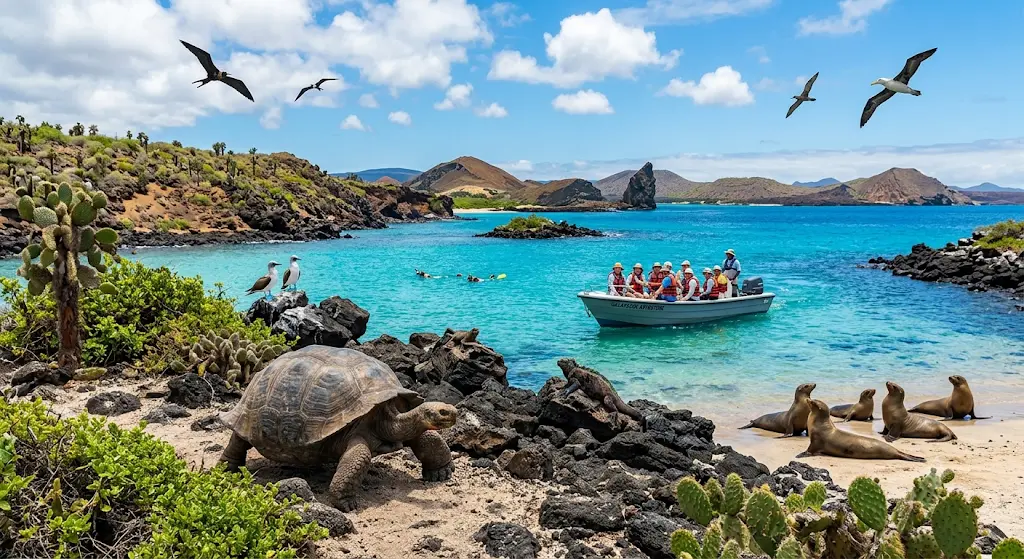
This is a guide to seven of them — Bartolomé, North Seymour, Los Túneles, Kicker Rock, Pinzón, Santa Fé and Floreana — written around what actually happens on the boat and on the trail. Which port each leaves from matters more than anything else, because the wrong departure island turns a good day into a logistics problem.
My honest opinion after running through all of them: if you only get one snorkel day, take Kicker Rock. If you only get one land day, take North Seymour. Everything else is a question of how much time and seasickness tolerance you have left.
Quick Facts: Galápagos Day Tours at a Glance
| Detail | What to Know |
|---|---|
| Departure ports | Puerto Ayora (Santa Cruz), Puerto Baquerizo Moreno (San Cristóbal), Puerto Villamil (Isabela) |
| Typical day length | 7 to 12 hours door to door, depending on crossing time |
| Guide requirement | Mandatory. Every National Park visitor site requires a certified naturalist guide |
| Group size | Usually 12 to 16 passengers per boat; guide ratio capped at 16 per guide |
| Included as standard | Guide, snorkel gear, wetsuit, lunch or box lunch, water, port transfers on the departure island |
| Not included | Park entrance fee (US$200 for most foreign adults since August 2024), transit control card (US$20), inter-island ferries, tips |
| Water temperature | Roughly 24–26°C December–May; 19–23°C June–November, colder in the west |
| Calmest seas | January to May. The garúa season, June to November, brings swell and grey skies |
| Booking window | North Seymour and Bartolomé sell out days ahead in July–August and December–January; the rest usually have space 24–48 hours out |
| Hardest crossing | Floreana and Los Túneles. Take medication before boarding, not after |
| Best single snorkel | Kicker Rock, if you are a confident swimmer. Pinzón or Santa Fé if you are not |
Bartolomé: The Photograph Everyone Recognises
Pinnacle Rock is the image on the cover of every Galápagos guidebook — a jagged spire of tuff rising out of a crescent bay, with Santiago’s coast behind it. You reach the viewpoint by climbing a wooden staircase of roughly 370 steps up a cinder cone. It takes about 40 minutes at a relaxed pace and there is no shade anywhere on it.
What surprises people is the ground itself. Bartolomé is barely 1.2 km², almost entirely bare volcanic rock, with spatter cones, lava tubes and tuff formations sitting in colours that shift from rust red to ochre to grey-black depending on the hour. Very little grows here beyond tiquilia, a low grey shrub that survives on almost no water. The comparison to a lunar surface gets overused, and it also happens to be accurate.
The snorkel at the base of Pinnacle Rock is where the Galápagos penguins turn up. Not always — they are unpredictable — but the small resident group hunts sardines in that bay and a penguin torpedoing past your mask at close range is a genuinely startling thing. White-tip reef sharks rest under ledges, green turtles graze the shallows, and the water is generally calm because the bay is sheltered.
Departure is from Santa Cruz or Baltra, and the crossing runs about two hours each way through the Itabaca Channel. That makes it a long day with a lot of boat time. The Bartolomé day tour is worth it for the landscape and the penguin odds, though anyone who hates stairs in equatorial heat should think twice.
North Seymour: Nesting Birds at Arm’s Length
North Seymour is flat, small and uplifted — a slab of submarine lava pushed above the waterline, which is why it has none of the volcanic drama of Bartolomé. What it has instead is density. The trail runs about 2 km in a loop, and along that loop sit magnificent frigatebird colonies, blue-footed booby nests, swallow-tailed gulls and land iguanas dozing under palo santo.
The birds nest directly beside the path. Boobies lay their eggs on bare ground inside a ring of guano, sometimes centimetres from where you are walking, and the guide will simply route you around them. Male frigatebirds inflate a scarlet throat pouch the size of a football and sit in the low bushes drumming their bills against it, clattering whenever a female passes overhead. That display peaks roughly March to June, though there is activity most of the year.
Blue-footed boobies court on open ground: each foot lifted in turn, held up, then a sky-point with beak and tail while whistling. The blue comes from carotenoids in fresh fish and fades within a couple of days if a male stops feeding well, so females are reading a live report on his fishing ability.
Crossing time from Baltra is short, under an hour, which makes this the most efficient wildlife hour in the archipelago. Most operators pair the North Seymour day tour with a snorkel or a beach stop at Las Bachas. Bring a lens you can shoot at two metres, because that is the legal minimum distance and the birds do not respect it from their side.
Los Túneles, Isabela: The Snorkel Site That Looks Engineered
Cabo Rosa sits about 45 minutes by fast boat southwest of Puerto Villamil, and the approach is the hard part. The boat has to time a break in the surf and run a shallow channel over the reef. When conditions are bad, captains turn back, and that decision gets made on the morning of the tour.
Once through, you are in a lagoon system where old lava flows collapsed into a lattice of arches and bridges standing in turquoise water a metre or two deep. Blue-footed boobies perch on the arches. The water underneath holds white-tip reef sharks stacked under ledges, green turtles that ignore you completely, golden rays, and — if your guide knows where to look — seahorses wrapped around mangrove roots.
The snorkelling here is easier than anywhere else on this list because the water is shallow, calm and clear, so it suits nervous swimmers and children. The walking portion across the lava bridges takes maybe 40 minutes. Book the Los Túneles snorkelling tour on Isabela, and take seasickness tablets an hour before boarding. The swell on that stretch is honest work.
Kicker Rock: Open Water, Hammerheads, No Beach
León Dormido rises 148 metres straight out of the ocean off San Cristóbal, split by a narrow channel that boats can only pass at certain states of the tide. You do not land anywhere. You get in the water at the base of a vertical wall with several hundred metres of ocean beneath you, and you swim the channel with the current.
That is the whole appeal and also the filter. Scalloped hammerheads gather in the channel, sometimes in schools, most reliably between June and November when the cool current runs. Galápagos sharks, blacktips, spotted eagle rays and enormous shoals of black-striped salema move through. Sea lions come to play in the shallows near the rock.
Visibility swings a lot — brilliant on a good day, murky when the plankton bloom is thick, which is the same water that brings the sharks. There is no shallow escape and no sand to stand on, so operators generally ask that you are comfortable in open water. Anyone who has swum laps and used a snorkel before will be fine. Anyone who has not should do Pinzón first and come back. The Kicker Rock day tour usually finishes at a beach on San Cristóbal, which softens the day considerably.
Pinzón: Turtles, Quietly
Pinzón has no visitor landing site. The island is closed, and that is deliberate: rats were eradicated here in 2012, and in 2014 rangers found naturally hatched giant tortoises surviving on Pinzón for the first time in more than 150 years. Keeping people off the land is part of why that worked.
The tour circles the island and snorkels its protected coves. Green turtles here are abundant and startlingly relaxed — you will find yourself finning slowly alongside one for several minutes while it grazes. White-tip sharks rest on sandy bottoms, sea lions patrol the rocks, and the reef fish are dense: parrotfish, king angelfish, Moorish idols, the occasional Galápagos garden eel colony in deeper sand.
Leaving from Puerto Ayora, this is a shorter, calmer day than Bartolomé, and it tends to be the tour people book when they want water time without drama. A Pinzón snorkelling tour often includes a stop at La Fé or a nearby bay, and the boat traffic here is noticeably lighter than at the headline sites.
Santa Fé: One Iguana That Exists Nowhere Else
Conolophus pallidus lives on Santa Fé and on no other piece of land on Earth. It is paler than the Galápagos land iguana — sandy yellow shading to near-white — with a more pronounced dorsal spine, and it disappears completely against the sun-bleached rock until it moves. Adults reach a metre and 11 kg or so, and they eat cactus, spines included.
The cactus in question is worth the trip on its own. Santa Fé’s giant prickly pear, Opuntia echios var. barringtonensis, grows trunks over ten metres tall with bark like a pine. It evolved that height for a reason: to lift its pads out of reach of the tortoises and iguanas that were eating them. The tortoises here went extinct in the 1800s, and the National Park reintroduced Española tortoises to the island in 2015 as ecological stand-ins.
The bay itself is a wide, turquoise, well-protected inlet with one of the archipelago’s larger sea lion colonies sprawled along the shore. Snorkelling is calm and shallow, and juvenile sea lions will spiral around you until they get bored. A Santa Fé day tour pairs a gentle trail with easy water, which makes it a sensible choice for mixed-ability groups and families.
Floreana: The Island With a Body Count
Floreana is the only day tour on this list where the human history competes with the wildlife, and it wins. This was the first island settled, in 1832. Whalers left mail in a wooden barrel at Post Office Bay from the 1790s onward, expecting homebound ships to carry the letters onward; the barrel is still there, still working, still run entirely on the honour system. You leave a postcard, you take one addressed near where you live, and you hand-deliver it.
Then there is the Baroness. In the 1930s a handful of European settlers arrived — a German doctor and his companion, a family called Wittmer, and an Austrian woman who declared herself empress of the island and arrived with two lovers and a revolver. Within three years the Baroness and one lover had vanished without trace, another man was found mummified on a beach far to the north, and the doctor was dead of poisoning. Nobody was ever charged. Margret Wittmer’s descendants still live in Puerto Velasco Ibarra.
The tour usually climbs to Asilo de la Paz in the highlands, where a freshwater spring — the reason anyone settled here at all — sits beside caves that pirates carved into the rock. There is a tortoise breeding enclosure nearby. Down at Punta Cormorant, a brackish lagoon holds American flamingos, and the beach is a green turtle nesting site between December and March.
Floreana is also the site of the largest island restoration project ever attempted in the archipelago, launched in 2023, aiming to clear rats and cats from an inhabited island and return a dozen locally extinct species. The crossing from Puerto Ayora runs about two hours and gets rough. Choose between the Floreana land tour for history and highlands, or the Floreana snorkelling tour if Devil’s Crown and the water matter more to you.
Comparison Table: The Seven Tours Side by Side
| Tour | Departs From | Crossing (one way) | Effort | Main Draw | Best Months |
|---|---|---|---|---|---|
| Bartolomé | Santa Cruz / Baltra | ~2 hours | Moderate — 370 steps, no shade | Pinnacle Rock, volcanic terrain, penguins | Year-round; penguins better Jun–Nov |
| North Seymour | Baltra / Santa Cruz | ~45 minutes | Easy — flat 2 km loop | Frigatebird and booby colonies, land iguanas | Mar–Jun for peak displays |
| Los Túneles | Puerto Villamil, Isabela | ~45 minutes, rough | Easy in water, uneven on lava | Lava arches, seahorses, resting sharks, turtles | Dec–May for calmer surf |
| Kicker Rock | Puerto Baquerizo, San Cristóbal | ~1 hour | Demanding — open-water snorkel | Hammerheads, Galápagos sharks, eagle rays | Jun–Nov for shark numbers |
| Pinzón | Puerto Ayora, Santa Cruz | ~1 hour | Easy — sheltered coves | Green turtles in numbers, quiet reef, few boats | Dec–May for visibility |
| Santa Fé | Puerto Ayora, Santa Cruz | ~1.5 hours | Easy to moderate | Endemic pale land iguana, giant Opuntia, sea lions | Year-round |
| Floreana | Puerto Ayora, Santa Cruz | ~2 hours, rough | Moderate — highland walking | Post Office Bay, pirate caves, flamingos, settler history | Dec–Mar for turtle nesting |
How to Build a Realistic Week
The mistake almost everyone makes is booking day tours on consecutive days from the same port. Two long crossings back to back will flatten you, and the third day you will skip breakfast and regret the money.
A sensible five-day pattern from Santa Cruz: one big boat day, one land day in the highlands with the tortoises, one more boat day, then a free day for Tortuga Bay or Las Grietas. If you are island-hopping, put Kicker Rock on your San Cristóbal days and Los Túneles on your Isabela days, because doing either from Santa Cruz means an extra ferry and a very early alarm.
The inter-island ferries themselves deserve a warning. They are open speedboats, they take two hours, and the crossing between Santa Cruz and Isabela in particular is uncomfortable enough that people cancel plans over it. Sit at the back, take the tablet before you board, and look at the horizon.
Budget beyond the tour price too. The park fee alone is US$200 per foreign adult, the transit card is US$20 at the mainland airport, and ferries run US$30–35 each way. Those add up faster than most people plan for.
A last practical note on gear. Bring reef-safe sunscreen, a rash guard, and a dry bag. Wetsuits come with the tour but their quality varies, and the water in the west during garúa season is cold enough that a thin suit stops being fun after twenty minutes. If you want more context on which species turn up where before you commit to islands, the guide to Galápagos Islands animals maps the wildlife against the archipelago. And if you would rather compare full itineraries than pick tours one by one, start with the full range of Galápagos day tours.
Final Thoughts
Day tours get treated as the budget option, the thing you do when you cannot afford a cruise. That framing undersells them. You sleep in a town, you eat dinner where locals eat, and you spend your money on an island economy that needs it. The trade-off is real — you will never reach Genovesa or Fernandina this way — but what you do reach, you reach properly, with time to sit down afterwards and think about it.
The moments that stay with people are almost never the ones on the brochure. A juvenile sea lion at Santa Fé dropping a sea star in front of your mask and waiting. The exact second a hammerhead resolves out of the blue at Kicker Rock and you realise how much larger it is than the photographs suggested. Margret Wittmer’s grandchildren running a small hotel on the island where three people vanished in 1934.
Pick two, maybe three, and give each one a full day. The archipelago rewards patience far more than it rewards coverage, and nobody comes home wishing they had spent more hours on a boat between sites.
Frequently Asked Questions About Galápagos Day Tours
Can I book Galápagos day tours after I arrive, or should I book ahead?
Both work, with one caveat. North Seymour and Bartolomé run limited daily permits and sell out several days in advance during July, August, December and January. Everything else usually has availability 24 to 48 hours out, and walking into an agency in Puerto Ayora the evening before often gets you a better price than booking online months ahead. If your trip is short and you cannot afford a lost day, book the two popular ones in advance and improvise the rest.
Do I need to be a strong swimmer for the snorkelling tours?
For Kicker Rock, yes. You enter deep open water with no beach and a current running through the channel, and while everyone wears a wetsuit for flotation, it is not a place to learn. Los Túneles, Pinzón and Santa Fé are shallow and sheltered, and guides routinely take people who have never snorkelled before. Say so when you book, and a good operator will keep you close and hand you a flotation ring.
Which day tour gives the best chance of seeing Galápagos penguins?
Bartolomé, at the base of Pinnacle Rock, is the accessible option from Santa Cruz. The larger populations live around Fernandina and western Isabela, so if you are staying in Puerto Villamil, the Las Tintoreras trip and Los Túneles both put you in better penguin water. Sightings are never guaranteed. The total population sits somewhere between 1,200 and 2,000 birds and drops sharply after strong El Niño years.
How much does a Galápagos day tour cost?
Most sit between US$120 and US$220 per person depending on the site, the boat and whether you book locally or in advance. That covers the guide, gear, lunch and transfers. It does not cover the US$200 park entrance fee, the US$20 transit control card, or inter-island ferries at roughly US$30–35 each way. Prices at the low end usually mean a slower, more crowded boat and a longer crossing.
Is it worth doing day tours instead of a Galápagos cruise?
It depends on which islands you care about. Cruises are the only way to reach Genovesa, Fernandina and Española, and they cover more ground while you sleep. Day tours cost substantially less, keep you off a boat overnight, and let you choose your food and your pace. If your list includes waved albatross or flightless cormorants, take a cruise. If it includes tortoises, boobies, sharks and turtles, day tours will deliver all of it.
What happens if the sea is too rough and my tour is cancelled?
Operators cancel on safety grounds, most often at Los Túneles, where the boat has to run a surf channel over the reef. You will normally be offered a different tour on the same day or a full refund. Cancellations cluster in the garúa season between July and October. Leave a buffer day at the end of your trip rather than scheduling a tour for the morning of your flight home.