You do not need a tour to snorkel in the Galápagos. That surprises people, because the whole archipelago has a reputation for being locked behind permits and guides, and much of it is. But half the beaches on this list sit within walking distance of a hostel, cost nothing, and hold sea turtles, white-tip sharks and sea lions in water shallow enough to stand in.
My blunt opinion: Concha de Perla on Isabela is the best free snorkel in the islands, and a lot of visitors never get there because it is not on any itinerary. It is a wooden boardwalk through mangrove, a set of steps, and then a natural pool where sea lions swim past your shoulder.
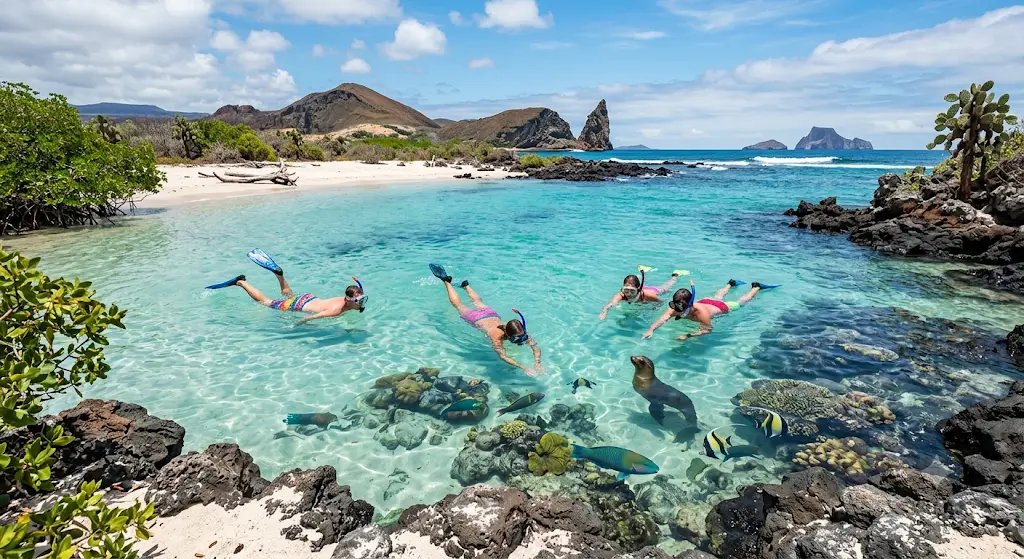
What follows is ten beaches sorted by what actually matters — whether you can walk in, how the water behaves, and what lives there. Four require a boat and a guide. Six do not.
Quick Facts: Snorkeling the Galápagos Beaches
| Detail | What to Know |
|---|---|
| Free walk-in beaches | Tortuga Bay, Playa Mann, La Lobería, Concha de Perla, Playa de los Alemanes, El Garrapatero, Station Beach |
| Guide required | Espumilla, Darwin Bay, Post Office Bay — all reached only by boat with a certified naturalist |
| Water temperature | 24–26°C December–May; 19–23°C June–November, colder around Isabela and Fernandina |
| Best visibility | January to May, when the seas calm and plankton thins out |
| Most reliable wildlife | Green turtles, Galápagos sea lions, white-tip reef sharks, golden and spotted eagle rays, marine iguanas |
| Gear | Rentals run US$5–10 a day in Puerto Ayora, Puerto Villamil and Puerto Baquerizo Moreno. Bring your own mask if you can |
| Wetsuit needed? | Yes for June–November if you want more than twenty minutes in the water. A rash guard suffices in the warm season |
| Minimum distance rule | Two metres from all wildlife. It applies underwater and the sea lions ignore it from their side |
| Sunscreen | Reef-safe only. A rash guard works better and does not wash off |
| Closing times | Tortuga Bay and El Garrapatero shut around 18:00. Rangers log you in and out at the Tortuga Bay gate |
The Walk-In Beaches
Tortuga Bay — Santa Cruz
The walk is 2.5 km of paved path from the edge of Puerto Ayora, uphill at first, through cactus forest and past finches that will land on the railing. Twenty-five minutes at a normal pace. You sign in at a ranger gate at the top.
The first beach you reach — Playa Brava — is not for swimming. The surf breaks hard and the rip is genuine, and marine iguanas lie along the sand in dozens, black on white, completely unbothered. Keep walking to the far end and you reach Playa Mansa, a shallow lagoon backed by mangrove where the water barely moves. Blacktip reef sharks cruise the shallows there, small ones, and green turtles feed in the seagrass. Bring your own gear; there is a kayak stand but no rental for masks.
Playa Mann — San Cristóbal
A ten-minute walk from the centre of Puerto Baquerizo Moreno, opposite the university campus. The snorkelling is unremarkable in terms of reef, but the sea lions are not. This beach functions as a colony, and there are usually forty or more animals on the sand at any hour, with pups nursing and juveniles wrestling in the shallows.
Get in the water at the rocky edges rather than the middle. Parrotfish, king angelfish and the occasional turtle work the rocks, and juvenile sea lions will follow you out and spiral around you until they lose interest. Sunset here is the local ritual, and the beach fills with residents at around 17:30.
La Lobería — San Cristóbal
Three kilometres from town, reachable on foot in about 45 minutes or by taxi for a couple of dollars. Rougher and wilder than Playa Mann, with black lava rock, a broad sea lion colony and marine iguanas in numbers along the shore.
The water here can pick up swell, and the entry is over rock, so reef shoes help. When it settles, the snorkelling is genuinely good — turtles, rays, dense schools of salema. There is a cliff trail beyond the beach worth walking for the frigatebirds and the view down onto the surf break.
Concha de Perla — Isabela
Five minutes from the ferry dock at Puerto Villamil. You walk a wooden boardwalk over mangrove, usually stepping around a sea lion asleep across it, and descend a set of steps directly into a natural tidal pool.
This is the easiest good snorkel in the archipelago. The water is protected, shallow, and clear, and it holds green turtles, rays, marine iguanas feeding on algae, and sometimes a Galápagos penguin. Sea lions use the platform as a bed. Go at high tide — at low tide the pool drains and the visibility collapses. It costs nothing. If you want more of the same coast with a guide, the Las Tintoreras snorkelling tour covers the islets just offshore where white-tip sharks stack up in a lava channel.
Playa de los Alemanes — Santa Cruz
Across the bay from Puerto Ayora, a short water taxi ride (about US$1) then a five-minute walk. Small, calm and sheltered by rock, which makes it the beach parents pick.
The snorkelling is modest — reef fish, some turtles drifting through, occasionally a ray. What makes it worth the trip is the combination: swim here, then walk fifteen minutes further to Las Grietas, a flooded volcanic crevice between two rock walls where you can swim in brackish water twelve metres deep. Different experience entirely, same afternoon.
El Garrapatero — Santa Cruz
Nineteen kilometres from Puerto Ayora on the eastern side, reached by taxi in about 40 minutes for around US$25 return, plus a ten-minute walk from the parking area. Fewer people come here, which is the point.
Long white sand, calm turquoise water, mangrove at the edges. The snorkelling holds turtles and rays, and the shallow brackish lagoon behind the beach draws flamingos, black-necked stilts and whimbrels. Bring water and food, because there is nothing for sale. Arrange your taxi return time before the driver leaves.
Station Beach — Santa Cruz
The strip of sand beside the Charles Darwin Research Station, a fifteen-minute walk east along the shore from the centre of Puerto Ayora. Rocky, small, and busy with marine iguanas and pelicans.
Snorkelling is limited but easy, and the real reason to come is that you can combine it with the tortoise breeding centre next door. Lonesome George’s preserved body is on display there. A Santa Cruz island tour normally covers the station along with the highland tortoise reserves, which is more efficient than doing it piecemeal.
The Boat-Only Beaches
Espumilla Beach — Santiago
A long stretch of golden sand on Santiago’s northwest coast, backed by mangrove and a saltwater lagoon. Green turtles nest here in numbers, and the tracks up the beach in the early morning are unmistakable.
Feral pigs used to dig up almost every nest on this beach. They were eradicated from Santiago in 2001 after a thirty-year campaign, and turtle nesting success has climbed since. Snorkelling is decent along the rocky ends, and the swell can be strong in the middle. Cruise itineraries reach it; day tours from the ports do not.
Darwin Bay — Genovesa
Genovesa is a collapsed caldera in the far northeast, and Darwin Bay sits inside the flooded crater. The cliffs above it hold red-footed boobies nesting in trees, great frigatebirds and Nazca boobies, which is why the island is called the bird island.
In the water: hammerheads occasionally, plus rays, sea lions and huge schools of fish against the caldera wall. Visibility is often excellent because the bay is deep and sheltered. Genovesa is cruise-only — no day tour from any inhabited island reaches it, and that isolation is exactly why the wildlife density is what it is.
Post Office Bay — Floreana
The barrel has been here since the 1790s, when whalers left letters for homebound ships to carry onward. It still works, still on the honour system. You leave a postcard, take one addressed near where you live, and deliver it by hand.
The snorkelling off the bay is average by Galápagos standards — sandy bottom, some rays, sea lions. The nearby site that justifies the crossing is Devil’s Crown, a sunken volcanic cone with strong current and a genuinely spectacular fish population. Choose between the Floreana land tour for the highlands and settler history, or the Floreana snorkelling tour if the water matters more.
Comparison: All Ten Beaches
| Beach | Island | Access | Water | What You’ll See |
|---|---|---|---|---|
| Tortuga Bay | Santa Cruz | Free, 25-min walk | Calm in the lagoon, dangerous on the surf side | Blacktip sharks, turtles, marine iguanas |
| Playa Mann | San Cristóbal | Free, 10-min walk | Calm, shallow | Sea lion colony, reef fish, occasional turtle |
| La Lobería | San Cristóbal | Free, 45-min walk or taxi | Variable, swell-prone | Sea lions, marine iguanas, turtles, rays |
| Concha de Perla | Isabela | Free, 5-min boardwalk | Very calm at high tide | Turtles, rays, sea lions, penguins sometimes |
| Playa de los Alemanes | Santa Cruz | Water taxi + short walk | Sheltered, very calm | Reef fish, turtles; Las Grietas nearby |
| El Garrapatero | Santa Cruz | Free, 40-min taxi | Calm | Turtles, rays, flamingos in the lagoon |
| Station Beach | Santa Cruz | Free, 15-min walk | Shallow, rocky entry | Marine iguanas, pelicans, small reef fish |
| Espumilla | Santiago | Cruise only, guide required | Swell in the centre, calm at the ends | Nesting turtles, rays, shorebirds |
| Darwin Bay | Genovesa | Cruise only, guide required | Deep, sheltered, clear | Hammerheads, rays, sea lions, seabird colonies |
| Post Office Bay | Floreana | Day tour or cruise, guide required | Calm; strong current at Devil’s Crown | Rays, sea lions, dense fish at Devil’s Crown |
Practical Notes Before You Get in the Water
Rental masks in the ports are hit and miss. A leaking mask ruins a good site, and a decent one costs less than two rentals, so bring your own if you have space. Fins matter less on the sheltered beaches and a lot at Devil’s Crown.
Tides matter more than most guides mention. Concha de Perla is transformed by them — brilliant at high tide, barely swimmable at low. Check the tide table pinned up at the Puerto Villamil dock before you walk down.
On wildlife etiquette: the two-metre rule is real and rangers enforce it. Sea lions will break it constantly from their side, and that is fine. What is not fine is chasing a turtle for a photograph or reaching for a ray. Territorial bull sea lions bark before they charge, and a bite from one puts you in a clinic in Puerto Ayora.
If you want to combine free beach days with the sites that genuinely need a boat, put one guided trip on each island you sleep on — the Kicker Rock day tour from San Cristóbal for sharks in open water, or the Pinzón snorkelling tour from Santa Cruz for turtles in quiet coves. The full list of Galápagos day tours is the place to compare crossings and prices, and the guide to Galápagos Islands animals maps which species live where.
Final Thoughts
The beaches on this list that stay with people are rarely the photogenic ones. Playa Mann has no reef worth describing, and it is still the beach where a two-month-old sea lion will lie down half a metre from your towel and go to sleep while its mother fishes.
What you are swimming in is a working ecosystem with a hard-won recovery behind it. Feral pigs came off Santiago in 2001 and turtle nests at Espumilla stopped being dug up. Rats came off Pinzón in 2012. The clear water and the animals that ignore you are the result of decades of unglamorous eradication work by Ecuadorian rangers.
Pick two or three, go at the right tide, and stay in longer than you planned. The archipelago rewards sitting still far more than it rewards ticking sites off a list.
Frequently Asked Questions About Snorkeling in the Galápagos
Can I snorkel in the Galápagos without booking a tour?
Yes, at seven of the ten beaches here. Tortuga Bay, Playa Mann, La Lobería, Concha de Perla, Playa de los Alemanes, El Garrapatero and Station Beach are all public, free and reachable on foot or by short taxi from the inhabited ports. Espumilla, Darwin Bay and Post Office Bay sit inside National Park visitor sites, which legally require a certified naturalist guide and a boat.
What is the best free snorkeling spot in the Galápagos?
Concha de Perla on Isabela. It sits five minutes from the Puerto Villamil ferry dock, costs nothing, and the sheltered pool holds green turtles, marine iguanas, rays and often a Galápagos penguin. Go at high tide. Tortuga Bay’s mangrove lagoon on Santa Cruz is the runner-up, with blacktip reef sharks in water you can stand up in.
Do I need a wetsuit to snorkel in the Galápagos?
Between June and November, yes, if you want more than twenty minutes in the water. The Humboldt current drops temperatures to 19–23°C and it is colder still around Isabela and Fernandina. From December to May a rash guard is usually enough. Shops in all three ports rent wetsuits for a few dollars a day, and guided tours include one.
Are there dangerous animals in the water?
The sharks are not the problem. White-tips, blacktips and even hammerheads have no record of attacks on snorkellers in the archipelago. The genuine risk is a territorial bull sea lion during breeding season, which barks a warning and will bite if you swim between him and his females. Give any barking male a wide berth and leave the water if one starts patrolling.
What is the best month for snorkeling in the Galápagos?
March and April. The water sits around 25–26°C, the seas are calm, and visibility is at its best. August and September bring colder, rougher water but far more marine life, including whale sharks off Darwin and Wolf and heavier shark activity at Kicker Rock. Neither window is wrong; they just reward different things.
How much should I budget for snorkeling gear?
Rentals cost US$5–10 per day in Puerto Ayora, Puerto Baquerizo Moreno and Puerto Villamil, and quality varies. Bringing your own mask and snorkel pays for itself in three days and removes the risk of a leaking mask spoiling a good site. Guided day tours include mask, snorkel, fins and wetsuit in the price, so you only need your own kit for the free beaches.