
September sits at the heart of the Galápagos garúa season, the cool, dry half of the year that runs from roughly June through November. It is the month when the Humboldt Current reaches its strongest influence over the archipelago, pushing cold, nutrient-dense water up the western flanks of Isabela and Fernandina and redistributing marine life across the entire island group. Air temperatures are mild, skies are frequently overcast in the highlands, and the sea is at its coldest and roughest of the year.
Those conditions produce a specific trade-off. Snorkeling requires a wetsuit and visibility is lower than in the warm months, but the volume of marine life is at its annual peak. Plankton blooms feed everything above them in the food chain, which concentrates fish, penguins, sea lions, sharks and seabirds into predictable feeding zones. For visitors whose priority is wildlife density rather than water comfort, September is among the strongest months of the year.
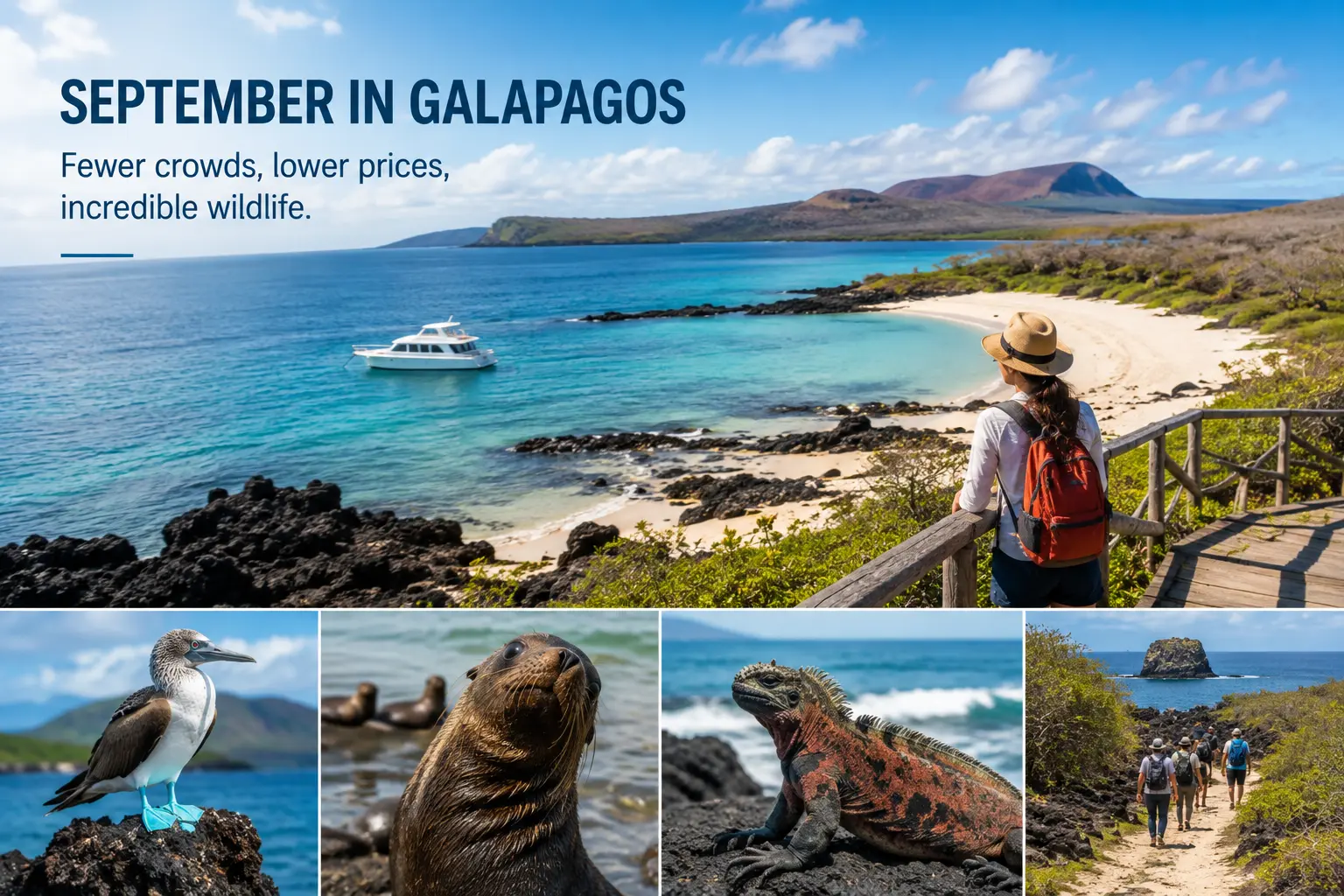
September also happens to be one of the quietest months for visitor numbers, falling between the northern hemisphere summer peak and the December holiday surge. Availability on popular day tours improves, hotel rates soften, and visitor sites are noticeably less congested. This guide sets out what to expect from the weather, which wildlife events are underway, and which excursions make the most of the conditions.
| Specification / Metric | Detail / Value |
|---|---|
| Season | Garúa (cool and dry), peak month of the Humboldt influence |
| Air temperature | Approx. 19–26 °C (66–79 °F); cooler and mistier in the highlands |
| Sea temperature | Approx. 19–23 °C (66–73 °F); coldest around western Isabela and Fernandina |
| Rainfall | Low at sea level; persistent drizzle and cloud cover in the highlands |
| Underwater visibility | Approx. 8–15 m, reduced by plankton density |
| Sea conditions | Choppiest of the year; southeast trade winds strongest in the afternoon |
| Wildlife highlights | Sea lion pupping and mating, waved albatross with chicks, active penguins, seabird feeding frenzies, hammerhead aggregations |
| Visitor volume | Low season; among the least crowded months of the year |
| Essential gear | Wetsuit (shorty or full 3 mm), light windbreaker, motion-sickness medication, reef-safe sun protection |
| Best suited to | Wildlife-focused travelers, snorkelers comfortable in cool water, photographers seeking uncrowded sites |
Background and Geography
The archipelago sits at the convergence of three major currents, and their seasonal balance determines almost everything a visitor experiences. Between June and November the cold Humboldt Current dominates from the southeast while the Cromwell Undercurrent upwells along the western shores, driving deep, nutrient-rich water toward the surface. The result is a cool ocean, a persistent temperature inversion that traps mist over the highlands, and one of the most productive marine environments on the planet.
September represents the strongest expression of this pattern. Surface temperatures bottom out, upwelling peaks, and the biological productivity that sustains the archipelago’s endemic marine species reaches its annual maximum. The same mechanism explains an apparent contradiction that surprises many first-time visitors: the water is least clear precisely when it holds the most life.
Primary Highlights and Key Features
Galápagos sea lions are the defining presence of the month. Pupping runs from roughly August through November, and September beaches across San Cristóbal, Española and Santa Fe hold newborn pups alongside territorial males patrolling the shoreline. Colonies are noisy, active and unusually approachable within the mandatory distance limits.
Waved albatross remain on Española, where the entire global breeding population nests. By September most pairs are tending well-grown chicks, and adults perform the courtship displays that make the island one of the most compelling seabird sites in the Pacific. The Española Island day tour is the only practical way to see the species, and its window closes when the birds depart around December.
Galápagos penguins track the cold water, becoming more active and more visible around Isabela and Bartolomé during upwelling months. Cool conditions also concentrate marine iguana feeding activity and increase the frequency of hammerhead sightings at deep-water sites, with Kicker Rock off San Cristóbal the most accessible aggregation point.
Distinctive Features and Visitor Dynamics
Cool-season snorkeling behaves differently from its warm-season counterpart. Reduced clarity is offset by far higher biomass, so encounters happen at closer range and last longer. Sheltered sites hold a clear advantage in September because they escape the afternoon swell: the lava channels and mangrove inlets of Los Túneles at Cabo Rosa and the shallow lagoons of Las Tintoreras on Isabela stay calm when open-water sites do not.
Boat transfers are the main comfort variable. Southeast trades strengthen through the day, so morning crossings are consistently smoother, and longer navigations to outlying islands can be uncomfortable for passengers prone to motion sickness. Land-based excursions sidestep the issue entirely, which is why the highland circuits and the Sierra Negra volcano hike perform well this month — cooler air makes the exposed caldera rim far more manageable than it is in March.
Seasonal and Environmental Conditions
Expect mild, overcast days rather than tropical heat. Coastal areas stay dry with intermittent sun, while the highlands of Santa Cruz and San Cristóbal sit under low cloud and light drizzle for much of the day. Ultraviolet levels remain high despite the cloud cover, a point regularly underestimated at this latitude.
In the water, a shorty wetsuit is the practical minimum and a 3 mm full suit is preferable for anyone spending more than half an hour snorkeling. Reputable operators supply wetsuits as standard during these months. Sea state peaks in the afternoon, and occasional port closures for safety are more common than in the calm season, so itineraries benefit from a buffer day before any onward flight.
Management, Conservation and Park Rules
All visitor sites operate under Galápagos National Park regulation, and September’s breeding activity makes the standard rules more consequential than usual. Visitors must remain on marked trails, stay at least two metres from wildlife, and travel with a certified naturalist guide at designated sites. Sea lion colonies with newborn pups require particular care: territorial bulls actively defend beach sections, and approaching a pup can cause a mother to abandon it.
Flash photography, feeding, and the introduction of any organic material between islands are prohibited. Site quotas and rotation schedules limit how many groups visit each landing per day, which is one reason low season delivers a noticeably better experience without any change in the rules themselves.
Practical Information for Travelers
Most September itineraries base out of Puerto Ayora on Santa Cruz, with San Cristóbal a strong alternative for sea lion and seabird activity. Day tours typically depart between 06:30 and 08:00 and return mid to late afternoon, with navigation times ranging from 40 minutes to just over two hours each way depending on the destination.
Pack layers rather than pure beachwear: a windbreaker for boat decks, closed shoes for volcanic terrain, and a dry bag for camera equipment. Booking remains advisable despite the low season, since operator capacity is capped and the strongest itineraries still fill. A structured overview of the options is available in our comparison of Galápagos day tours, and species-by-species detail is covered in the guide to Galápagos wildlife.
Final Thoughts
September illustrates a principle that governs the entire archipelago: the Galápagos is not a destination with a single optimal season, but a system that presents different phases of the same ecological cycle throughout the year. The cool-season upwelling that makes the water uncomfortable is the identical process that sustains penguins on the equator, supports the largest marine iguana populations, and fuels the seabird colonies that define the islands’ scientific significance.
That relationship carries broader relevance. The productivity of these months depends on current systems that respond directly to Pacific climate variability, and El Niño events periodically suppress the upwelling with measurable consequences for breeding success across multiple species. Long-term monitoring of cool-season conditions has become one of the more useful indicators of how eastern Pacific ecosystems absorb climatic stress.
For the traveler, the practical conclusion is straightforward. September rewards those who prioritize wildlife behaviour over water temperature and who value uncrowded sites over guaranteed clarity. It is a working month in the archipelago’s calendar rather than a showcase one, and the difference is visible at almost every landing site.
Frequently Asked Questions About Visiting the Galápagos in September
Is September a good month to visit the Galápagos?
Yes, particularly for wildlife. September falls within the cool, dry garúa season, when nutrient-rich upwelling drives the highest marine productivity of the year. Sea lion pupping is underway, seabird activity peaks, and penguins are unusually active. The trade-offs are colder water, choppier seas and reduced underwater visibility, all of which are manageable with a wetsuit and a morning-departure itinerary.
How cold is the water in the Galápagos in September?
Sea temperatures generally range from 19 to 23 °C (66 to 73 °F), with the coldest readings around western Isabela and Fernandina where the Cromwell Undercurrent upwells most strongly. A shorty wetsuit is the practical minimum for snorkeling and a 3 mm full suit is more comfortable for longer sessions. Established operators include wetsuit rental during these months.
What wildlife can I see in the Galápagos in September?
Sea lion pups and territorial mating behaviour dominate the beaches from August through November. Waved albatross are still nesting on Española with well-grown chicks, blue-footed and Nazca boobies feed in large groups, and Galápagos penguins are more active in the cooler water. Hammerhead sharks aggregate at deep-water sites, and whales and dolphins are sighted more frequently than in the warm season.
Is September a crowded month in the Galápagos?
No. September sits between the northern hemisphere summer peak and the December holiday period, making it one of the lowest-demand months of the year. Day tour availability improves, accommodation rates soften, and visitor sites are less congested. National Park quotas remain unchanged, so smaller group sizes at landings are a direct result of lower demand rather than any change in regulation.
Are the seas rough in September and will I get seasick?
September has the roughest sea conditions of the year, driven by strong southeast trade winds that build through the afternoon. Morning crossings are noticeably smoother. Travelers prone to motion sickness should take medication 30 to 45 minutes before boarding, choose destinations with shorter navigation times, and consider balancing boat-based excursions with land-based options such as highland circuits or volcano hikes.
What should I pack for a September trip to the Galápagos?
Bring layers rather than warm-weather clothing alone: a light windbreaker for boat decks, quick-dry clothing, and a fleece for cool highland mornings. Closed shoes with grip are necessary for volcanic terrain, and a dry bag protects camera gear from spray. High-factor reef-safe sun protection remains essential despite frequent cloud cover, since equatorial ultraviolet levels stay elevated regardless of the weather.