Galápagos giant tortoises are the only remaining wild population of large tortoises in the Northern Hemisphere’s tropical Pacific, and they are far easier to see than most visitors expect. Unlike the archipelago’s marine species, tortoises are terrestrial, slow moving and concentrated in a small number of accessible habitats, which means a well planned day can produce sightings of dozens of animals.
Where you see them, however, determines what you see. Wild tortoises in the Santa Cruz highlands or on the flanks of Alcedo Volcano behave differently from animals in the fenced enclosures of a breeding centre, and the two experiences serve different purposes. Ranches offer free ranging adults in a semi agricultural landscape, breeding centres show juveniles and the mechanics of population recovery, and remote volcanic slopes hold the largest concentrations but require multi day expedition access.
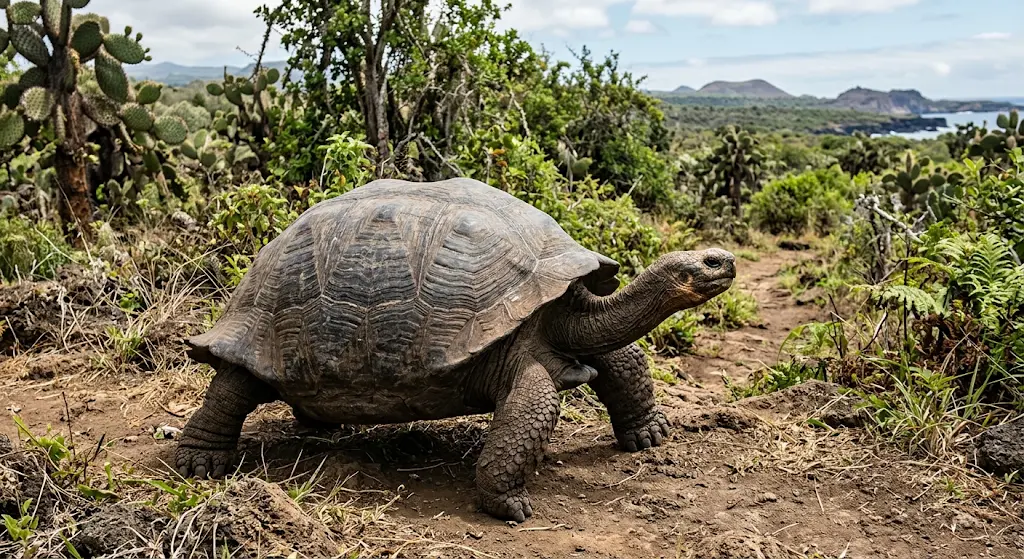
Taxonomy also matters when planning. What was long treated as a single species is now recognised as a complex of roughly 15 species, of which 12 to 13 survive. Each is tied to a specific island or volcano, and shell shape differs measurably between them: domed carapaces on humid highland islands, saddlebacked shells on arid lowland islands where animals must reach upward for vegetation.
| Location | Type | Access and Notes |
|---|---|---|
| El Chato / Rancho Primicias, Santa Cruz | Wild, free ranging on private land | 45 min from Puerto Ayora; entry roughly US$5 to US$10; boots supplied |
| Charles Darwin Research Station, Santa Cruz | Breeding centre | Walking distance from Puerto Ayora; free entry; juveniles and adults |
| Arnaldo Tupiza Centre, Isabela | Breeding centre | Short walk or taxi from Puerto Villamil; five Isabela lineages |
| La Galapaguera, San Cristóbal | Semi wild reserve and breeding centre | About 40 min from Puerto Baquerizo Moreno; included on most island tours |
| Alcedo Volcano, Isabela | Wild, largest population | Multi day guided expedition; permit and camping required |
| Urbina Bay, Isabela | Wild, cruise visitor site | Wet landing; accessible only on western itineraries |
| Best months in the highlands | Seasonal migration | June to December for adults in highlands; nesting in lowlands January to May |
| Adult size and lifespan | Biometrics | Up to 250 kg and 1.5 m; commonly over 100 years |
| Minimum approach distance | Park rule | 2 metres; no touching, feeding or blocking movement |
Why the Highlands Concentrate Tortoises for Half the Year
Tortoise distribution follows moisture. During the cool garúa season from roughly June to December, persistent mist condenses on the windward slopes above 200 metres, keeping grasses and herbaceous plants green while the coastal zone dries out. Adults migrate upslope along traditional routes used for generations, which is why the Santa Cruz highlands hold high densities in exactly those months.
The pattern reverses from January to May. Warmer, more sporadic rainfall greens the lowlands, and females descend to arid coastal zones to nest in sandy soils, digging chambers and laying clutches of roughly 4 to 16 eggs. Incubation lasts four to eight months, and sex is determined by nest temperature, with warmer nests producing more females. Neither season eliminates sightings, but the highland ranches are noticeably busier with animals in the second half of the year.
Santa Cruz: The Most Reliable Place to See Wild Adults
The El Chato Tortoise Reserve and the adjacent private ranches, principally Rancho Primicias and Rancho El Manzanillo, sit in the agricultural belt roughly 45 minutes by road from Puerto Ayora. Tortoises move freely between National Park land and these properties, so the animals are genuinely wild despite the setting. Rubber boots are provided, since the ground is often muddy, and trails cross pasture, guava thicket and lava tubes that visitors can walk through.
Most highland itineraries combine tortoises with Los Gemelos, the twin pit craters formed by magma chamber collapse, and a scalesia forest section, a combination covered in our Santa Cruz island tour. The Charles Darwin Research Station, on the eastern edge of Puerto Ayora, complements this with the captive side of the story, including corrals of juveniles marked by island of origin and the preserved body of Lonesome George, the last Pinta Island tortoise, who died in 2012.
Isabela and San Cristóbal: Different Lineages, Different Terrain
Isabela is the archipelago’s tortoise stronghold. Five volcanoes on the island each hold a distinct species, isolated from one another by lava fields that the animals cannot cross. The Arnaldo Tupiza Breeding Centre outside Puerto Villamil rears juveniles from several of these lineages, and sits close to the flamingo lagoon and the trail network described in our Las Tintoreras tour. Visitors climbing to the caldera on the Sierra Negra volcano day tour occasionally encounter wild tortoises on the lower slopes, though sightings there are incidental rather than guaranteed.
On San Cristóbal, La Galapaguera de Cerro Colorado combines a breeding facility with a large fenced natural area where adults roam through arid zone vegetation. It appears on most circuits of the island, including the 360 San Cristóbal tour, usually paired with coastal snorkelling stops.
Sites Reachable Only by Cruise
Two of the best wild tortoise locations lie outside day tour range. Urbina Bay on western Isabela sits on a section of seafloor uplifted several metres during a 1954 volcanic event, and its vegetated flats hold large Alcedo tortoises alongside land iguanas. Access requires a wet landing from a vessel on a western itinerary. The Alcedo Volcano caldera rim, home to the largest single population in the archipelago, is reached only by permitted multi day trekking expeditions with camping and a licensed guide.
Travellers prioritising these sites should check vessel routing before booking, since only a subset of boats run the western circuit. Options and cost structures are set out in our guides to naturalist cruises and to Galápagos cruise costs.
Rules, Distances and Conservation Context
National Park regulations apply at every site, including private ranches. Visitors must stay at least two metres from any tortoise, must not touch, feed or ride the animals, and must never block a migration path or approach a tortoise that has withdrawn into its shell, since the hissing sound is an alarm response, not a greeting. Flash photography is prohibited, and drones require specific authorisation.
The conservation backdrop explains the strictness. Whaling and sealing fleets removed an estimated 100,000 to 200,000 tortoises during the eighteenth and nineteenth centuries, and introduced goats, pigs, rats and fire ants later attacked eggs, hatchlings and habitat. Captive rearing programmes, running since 1965, have repatriated thousands of juveniles, most notably to Española, whose population recovered from 15 surviving adults. Introduced species remain the primary ongoing threat, which is why visitors pass biosecurity inspection on arrival and why boot cleaning stations appear at highland sites.
Practical Planning Notes
Highland visits are physically easy, involving flat walking on uneven, often wet ground for one to two hours. Closed footwear is essential, long trousers help in guava scrub, and rain protection is worth carrying between June and December when the highlands sit under cloud. Mornings tend to be cooler and animals more active, and midday heat drives tortoises toward ponds and shade, which concentrates them in predictable spots.
Day tour operators typically combine highlands with a beach or snorkelling component; those weighing itineraries can compare formats in our day tour comparison. Ranch entry fees are paid separately in cash, and the National Park entrance fee covers reserve access rather than private property.
Final Thoughts
The Galápagos giant tortoise occupies an unusual position in conservation biology: a species complex that was nearly extinguished by commercial exploitation, then rebuilt through one of the longest running captive breeding programmes in the world. The Española population, restored from a founding group of 15 animals, is now self sustaining, and Pinzón hatchlings survived in the wild for the first time in more than a century after rodent eradication in 2012.
Those recoveries also demonstrate why the animals matter ecologically rather than only symbolically. Tortoises are the archipelago’s principal seed dispersers and large herbivores, shaping vegetation structure across the islands they occupy. Their removal altered plant communities measurably, and their return has begun to reverse those changes, a process now monitored through GPS tracking of migration routes on Santa Cruz and Isabela.
For visitors, the practical implication is that tortoise viewing is not a static attraction but a window into an active management programme. The juveniles in a breeding corral on Isabela are numbered, assigned to a lineage and destined for release on a specific volcano. Understanding that framework changes what a highland ranch visit represents: not a zoo alternative, but the visible surface of a fifty year effort to restore the animals for which the archipelago was named.
Galápagos Giant Tortoises FAQ
What is the best month to see wild tortoises in the highlands?
June through December is the strongest window, when garúa mist keeps highland vegetation green and adults migrate upslope. Sightings continue year round, but densities at Santa Cruz ranches drop somewhat between January and May, when many females move to lowland nesting areas.
Can I see tortoises without joining a tour?
Yes. From Puerto Ayora, a taxi to the highland ranches costs roughly 25 to 40 dollars round trip with waiting time, plus the ranch entry fee. The Charles Darwin Research Station is a 20 minute walk from town and free to enter, though a guide adds useful interpretation.
How close can I get to a giant tortoise?
Park rules require a minimum distance of two metres, with no touching, feeding or blocking of movement. A tortoise that hisses and retracts its head is showing an alarm response, so the correct action is to step back and allow the animal to continue undisturbed.
What is the difference between domed and saddleback tortoises?
Domed shells occur on larger, humid islands such as Santa Cruz where vegetation grows at ground level. Saddleback shells, raised at the front, evolved on arid islands like Española and Pinta, allowing animals to extend their necks upward to reach cactus pads and higher browse.
Do I need special footwear for highland ranches?
Closed shoes are required, and the ground is frequently muddy. Most ranches lend rubber boots at no extra cost, but bringing socks and long trousers is advisable, since trails pass through wet grass and guava thicket where sharp regrowth is common.
Are the tortoises at ranches wild or captive?
They are wild. Ranches such as Primicias and El Manzanillo sit on migration corridors, and tortoises move freely between farmland and adjacent National Park territory. Fences are designed to allow tortoise passage, so animals are present by choice rather than confinement.