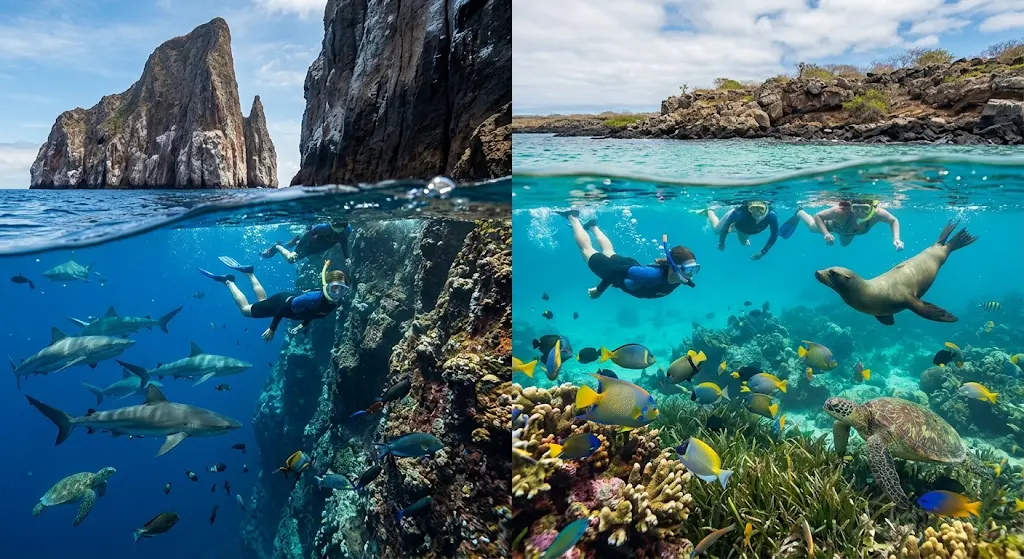
Two of the most requested snorkeling day tours in the Galápagos depart from different islands, sit roughly 90 kilometers apart, and deliver almost opposite experiences in the water. Kicker Rock, known locally as León Dormido, is a vertical volcanic monolith rising from open ocean off San Cristóbal, where snorkelers float above a channel more than 20 meters deep. Pinzón Island, in the geographic center of the archipelago near Santa Cruz, offers sheltered bays, shallow reef edges, and calmer conditions along a coastline that no visitor is permitted to walk on.
The comparison matters because these tours are not interchangeable. One is a deep-water, high-adrenaline encounter with pelagic species and demands genuine swimming confidence. The other prioritizes reef biodiversity, visibility close to shore, and accessibility for families and less experienced snorkelers. Choosing incorrectly is the single most common source of disappointment among visitors booking snorkeling excursions, particularly when travelers assume that “best” is an absolute rather than a function of their own comfort in open water.
This guide compares both tours across the criteria that actually determine satisfaction: water depth and current strength, realistic wildlife probabilities, boat time, physical difficulty, seasonal variability, and the National Park regulations that govern each site. Neither destination is objectively superior. The useful question is which one matches your skill level, your base island, and the species you most want to see.
| Specification / Metric | Kicker Rock (León Dormido) | Pinzón Island |
|---|---|---|
| Departure point | Puerto Baquerizo Moreno, San Cristóbal | Puerto Ayora, Santa Cruz |
| Navigation time (one way) | Approx. 1 to 1.5 hours | Approx. 1.5 to 2 hours |
| Total tour duration | 7 to 8 hours | 7 to 8 hours |
| Water depth at snorkel site | 20–30+ meters (open channel) | 3–12 meters (protected bays) |
| Difficulty level | Intermediate to advanced | Beginner to intermediate |
| Signature species | Hammerhead and Galápagos sharks, eagle rays, sea turtles | White-tipped reef sharks, sea turtles, rays, reef fish |
| Land visit permitted | No landing on the rock; beach stop at Cerro Brujo or Manglecito | No landing on Pinzón; beach stop on Santa Cruz coastline |
| Water temperature range | 19–26 °C depending on season | 20–27 °C depending on season |
| Wetsuit requirement | Essential year-round | Recommended, essential July–November |
| Best months | June–November for shark density; January–May for visibility | December–May for warm, calm water |
A Collapsed Ash Cone and a Rat-Free Island: Where Each Site Comes From
Kicker Rock is the eroded remnant of a volcanic tuff cone, formed from compacted ash deposited during explosive submarine eruptions. Marine erosion has since carved it into two vertical towers separated by a narrow channel, with the formation rising roughly 140 meters above sea level. Because the structure sits several kilometers offshore in open water, it functions as an isolated vertical wall dropping into deep ocean — a topography that concentrates nutrients and attracts pelagic species uncommon near coastal reefs. It lies within the northeastern sector of the Galápagos Marine Reserve, accessible from San Cristóbal Island.
Pinzón occupies a completely different geological and ecological position. It is a small, uninhabited island of approximately 18 square kilometers, formed by shield volcanism and located near the archipelago’s center. Its coastline includes protected coves where wave energy is dissipated before reaching shore, producing conditions markedly gentler than those at exposed offshore pinnacles. Pinzón is also one of the most significant conservation case studies in the archipelago: after the eradication of invasive rats in 2012, the island’s endemic giant tortoises produced naturally surviving hatchlings for the first time in more than a century.
Pelagic Wall Versus Resident Reef: What You Actually See Underwater
At Kicker Rock, the central attraction is the channel itself. Snorkelers enter from a panga and drift along the wall while the current carries them through the gap between the two towers. Schooling hammerhead sharks are the species most associated with the site, though sightings are never guaranteed and depend heavily on season, depth and water clarity. Galápagos sharks, blacktip reef sharks, spotted eagle rays, green sea turtles and large schools of creolefish are all regularly encountered. Blue-footed boobies, Nazca boobies and frigatebirds nest on the ledges above, adding an ornithological component visible from the boat.
Pinzón tours emphasize reef ecology rather than pelagic encounters. The bays hold white-tipped reef sharks resting in overhangs, green sea turtles grazing on algae, golden and marbled rays, sea lions, and dense concentrations of parrotfish, surgeonfish, angelfish and king angelfish. Visibility close to shore is often excellent, and because depths are moderate, marine life appears closer and remains in view longer. Many itineraries combine Pinzón with a second snorkel stop and a beach visit on the Santa Cruz coast, structurally similar to the format used on the Santa Fe snorkeling tour.
Depth, Current, and the Comfort Threshold That Decides the Day
The decisive difference is psychological as much as physical. At Kicker Rock there is no shallow refuge, no sand below, and no option to stand up. Snorkelers float above open blue water with the seabed far out of sight, occasionally in currents strong enough to require steady, continuous swimming. Visitors uncomfortable with depth perception or with sharks passing beneath them frequently cut the session short. Guides typically brief groups on staying together and maintaining a horizontal profile to avoid drifting past the channel exit.
Pinzón removes almost all of these stress factors. Entries are calmer, the seabed is visible, and swimmers who need to rest can do so without anxiety. Flotation vests are standard on both tours, but at Pinzón they function as comfort aids rather than as a necessary safety margin. For travelers building a first snorkeling experience before attempting more demanding sites, this island pairs logically with sheltered options such as Las Tintoreras on Isabela.
Cool Season, Warm Season: How the Calendar Shifts the Odds
Both sites follow the archipelago’s two-season cycle. From December through May, the warm season brings water temperatures near 24–27 °C, calmer seas, and generally better underwater visibility. From June through November, the Humboldt Current pushes cooler, nutrient-rich water into the archipelago, dropping temperatures to 19–23 °C and increasing plankton density.
These conditions affect each site differently. At Kicker Rock, the cool season reduces visibility but increases the probability of large shark aggregations, since nutrient-rich water attracts the fish that predators follow. At Pinzón, the warm season is the clearer advantage: gentler swells, warmer water, and better light penetration in shallow bays. Travelers planning shoulder-season trips can review conditions in detail in the September travel guide.
Why Neither Site Allows a Landing
Both locations are governed by Galápagos National Park regulations and require a certified naturalist guide. Landing on Kicker Rock is prohibited, as is climbing any part of the formation. Pinzón is closed to visitors on land, protecting its recovering tortoise population and its rat-free status; only marine sites along the coast are authorized.
Standard rules apply across the archipelago: no touching or chasing marine animals, no feeding, minimum approach distances of two meters where practical, and no removal of shells, coral or sand. Reef-safe sunscreen is strongly encouraged, and biosecurity checks at airports and docks exist to prevent the introduction of invasive species. Site visits are scheduled to limit vessel concentration, which is why departure times are fixed rather than flexible. A broader overview of regulated species encounters is available in the Galápagos wildlife guide.
Base Island, Boat Time, and the Gear That Actually Matters
Base island determines feasibility more than preference does. Kicker Rock is only practical from San Cristóbal, and Pinzón only from Santa Cruz; neither is a realistic same-day excursion from the other island once ferry schedules are factored in. Both tours run roughly seven to eight hours door to door and include guide, snorkeling equipment, wetsuit and lunch in most packages.
Essential gear includes a wetsuit for thermal protection, a well-fitted mask, reef-safe sun protection, a hat, a light windbreaker for the return crossing, and a dry bag for cameras. Motion sickness medication is advisable for the Kicker Rock crossing in particular, since open-water swell is common. Travelers comparing full-day options across islands can consult the day tour comparison guide, and those prioritizing shoreline snorkeling may prefer the routes covered in the best beaches and snorkeling roundup. Direct booking details for each excursion are available on the Kicker Rock day tour and Pinzón Island snorkeling tour pages.
Weighing the Two Sites: A Closing Assessment
The contrast between these two sites illustrates a broader principle in Galápagos marine ecology: proximity to deep water changes everything. Kicker Rock’s vertical wall intercepts oceanic currents, drawing in migratory predators that rarely approach shallow coastal habitat. Pinzón’s sheltered bays support a resident reef community structured around algae grazing, substrate cover and predictable temperature ranges. Both are products of the same archipelago, yet they function as distinct ecological systems separated by less than a hundred kilometers.
For visitors, this argues against treating the two as competing products. A traveler with limited time and strong swimming ability will extract more value from Kicker Rock, where the probability of encountering large pelagic species is meaningfully higher than at almost any other accessible day-tour site. A traveler with children, limited open-water experience, or a preference for sustained observation of reef life will find Pinzón the more rewarding investment, and will spend more total minutes actively engaged in the water rather than managing discomfort.
The conservation dimension deserves equal weight. Pinzón’s tortoise recovery following invasive rodent removal ranks among the more consequential restoration outcomes in the Pacific, and the island’s closure to land visitors is a direct condition of that success. Kicker Rock’s protection reflects a different priority: safeguarding an aggregation site for shark species facing severe pressure elsewhere in the eastern Pacific. Visiting either responsibly means accepting that access is deliberately constrained, and that the restrictions are the reason the encounters remain possible.
Frequently Asked Questions About Kicker Rock and Pinzón Snorkeling
Which tour is better for beginner snorkelers?
Pinzón is clearly better suited to beginners. Snorkeling takes place in protected bays with depths of roughly three to twelve meters, minimal current, and a visible seabed, which reduces disorientation. Kicker Rock requires floating in open water more than twenty meters deep, with no shallow area to retreat to and occasional currents that demand continuous swimming.
Are hammerhead shark sightings guaranteed at Kicker Rock?
No. Hammerheads are seasonal and behave unpredictably, and sightings depend on water temperature, nutrient conditions, time of day and visibility. Probability increases during the cool season between June and November, but no operator can guarantee an encounter. Galápagos sharks, blacktip reef sharks, turtles and eagle rays are seen far more consistently.
Can I visit both sites on the same trip?
Yes, but not on the same day. Kicker Rock departs from Puerto Baquerizo Moreno on San Cristóbal, while Pinzón departs from Puerto Ayora on Santa Cruz. The inter-island ferry between them takes roughly two hours each way, so the two excursions require separate days and, in practice, at least one night on each island.
Why can’t visitors land on Pinzón Island?
Pinzón is a restricted conservation zone. Following the eradication of invasive rats in 2012, its endemic giant tortoises resumed successful natural reproduction for the first time in over a century. Keeping the island free of human landings minimizes the risk of reintroducing invasive species and protects the recovering population.
Do I need a wetsuit for these tours?
A wetsuit is essential at Kicker Rock throughout the year, since water temperatures in the open channel can fall to around 19 °C during the cool season. At Pinzón a wetsuit is recommended year-round and effectively necessary between July and November. Most operators include wetsuit rental in the tour price, but confirming this in advance is advisable.
How rough is the boat crossing to each site?
The crossing to Kicker Rock takes about one to one and a half hours and passes through open water where swell is common. Pinzón requires a longer navigation of roughly one and a half to two hours from Puerto Ayora, though much of the route is comparatively sheltered. Motion sickness medication taken thirty to sixty minutes before departure is recommended for both.