Darwin and Wolf lie roughly 160 to 200 kilometers northwest of the central Galápagos islands, isolated by open ocean and closed to all land visitors. Neither island has a trail, a landing site or a ranger station. They appear on itineraries for a single reason, which is that the water surrounding them holds the highest shark biomass ever measured in any marine ecosystem on Earth, a finding published after surveys conducted in the mid 2010s and a central argument behind their formal protection.
Access is tightly controlled. Only a limited fleet of specially permitted Galápagos diving liveaboards holds authorization to operate in this northern sector, and reaching it requires an overnight crossing of open water. Everything a diver does here happens below the surface, usually along vertical walls swept by current, at depths between 9 and 30 meters, with the boat waiting above rather than at anchor near a beach.
This guide covers the geology behind the two islands, the species encountered, how conditions shift across the year, the regulations that govern diver behavior, and the certification and equipment thresholds that operators apply before accepting a booking.
| Specification / Metric | Detail / Value |
|---|---|
| Location | Far northern Galápagos, beyond the main archipelago platform |
| Land area | Darwin about 1.1 km², Wolf about 1.3 km² |
| Land access | Prohibited. Diving and surface support only |
| How to reach them | Permitted dive liveaboard only, no day tours |
| Crossing time from Baltra or Santa Cruz | Roughly 12 to 16 hours of overnight navigation to Wolf |
| Wolf to Darwin leg | Approximately 1 to 2 hours of additional navigation |
| Typical dive depth | 9 to 30 meters, recreational limits, no decompression diving |
| Minimum experience | Advanced certification plus 50 to 100 logged dives, drift experience required |
| Water temperature | About 21 to 25 °C from June to November, 24 to 29 °C from December to May |
| Whale shark season | June through November, peaking around August and September |
| Signature species | Scalloped hammerheads, whale sharks, Galápagos and silky sharks, eagle and mobula rays, dolphins |
| Essential gear | 5 to 7 mm wetsuit with hood, gloves, dive computer, SMB, audible alert, GPS beacon recommended |
| Governing authority | Galápagos National Park Directorate and the Galápagos Marine Reserve |
Two Volcanic Remnants Standing Alone in the Open Pacific
Both islands are the eroded summits of extinct volcanoes that rise from a separate submarine platform north of the main archipelago, and both are considerably older than the young, still active volcanoes of Isabela and Fernandina. Wolf, named after the German geologist Theodor Wolf and formerly charted as Wenman, reaches roughly 253 meters at its highest point. Darwin, once known as Culpepper, tops out near 168 meters. What remains above water is a fraction of the original structure, while the productive habitat lies on the submerged slopes below.
Their isolation is the entire point. Sitting directly in the path of the Equatorial Undercurrent, also called the Cromwell Current, the two seamounts force deep, nutrient rich water upward against their walls. That upwelling feeds enormous baitfish aggregations, which in turn concentrate large pelagic predators in a very small area. The result is a natural gathering station in the middle of open ocean rather than a coastal reef system.
In 2016, Ecuador declared the waters around Darwin and Wolf a no take marine sanctuary covering roughly 38,000 square kilometers. In 2022 the country added the Hermandad Marine Reserve, approximately 60,000 additional square kilometers protecting the migratory corridor that links the Galápagos with Cocos Island in Costa Rica. Satellite tagging of hammerheads, whale sharks and sea turtles supplied the scientific case for both measures.
Hammerhead Walls, Whale Sharks and the Pillars of Evolution
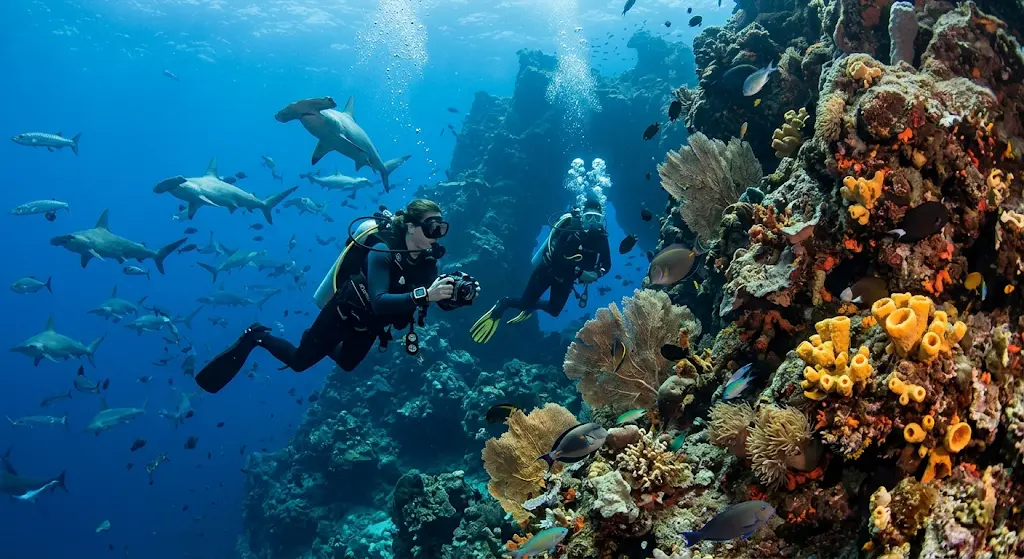
At Darwin, nearly all diving happens along a single stretch known as Darwin’s Theater, a shelf and wall system that descends into blue water. Divers typically settle onto the rocky bottom between 15 and 25 meters and watch schools of scalloped hammerheads cycle past in numbers that can reach the hundreds. Above the shelf, the famous arch collapsed in May 2021, leaving two rock columns now officially called the Pillars of Evolution. The dive site itself was unaffected by the collapse.
Wolf offers more variety across several named sites, including Shark Bay, El Derrumbe, La Banana and The Landslide. Terrain here ranges from boulder fields to steep walls and sandy channels. Galápagos sharks patrol the drop offs, silky sharks often appear during safety stops, and bottlenose dolphins pass through with some regularity. The sandy patches at both islands also hold the red lipped batfish, an odd looking endemic that rewards divers willing to look down rather than out.
Whale sharks are the headline attraction at Darwin. The individuals recorded here are overwhelmingly large, apparently pregnant females, a pattern documented by long running photo identification research and unusual among global whale shark aggregations, where juvenile males normally dominate. Sightings are seasonal and never guaranteed, but the probability during the cool months is higher here than almost anywhere else. Divers comparing this to shallower, more accessible encounters can review the difference between liveaboard and day diving before committing to a week at sea.
Current, Surge and the Reason These Sites Demand Experience
Conditions at Darwin and Wolf are not comparable to the sheltered central island sites. Current is the defining variable, frequently running strong and occasionally shifting direction mid dive. Entries are typically negative, meaning divers deflate and descend immediately on giant stride to avoid being pushed off the site before reaching the bottom. Surge along the walls can be significant, and thermoclines of several degrees appear without warning.
Divers hold position against bare rock rather than drifting, since reef hooks are not used in the Galápagos Marine Reserve. Gloves are permitted and genuinely useful for gripping volcanic rock. Ascents are made into blue water with the boat tracking surface markers, which is why a delayed surface marker buoy is mandatory and a personal GPS beacon is strongly advised. Nitrox is standard on most vessels and extends bottom time at these depths.
Wildlife behavior also differs. Sharks here are habituated to divers and largely indifferent, provided divers stay low, breathe calmly and avoid chasing. Erratic swimming, flash photography aimed at hammerheads and rapid approach all disperse the schools, which is why briefings emphasize stillness over movement. Those curious about the wider fauna of the archipelago can consult the overview of Galápagos wildlife species.
How Temperature and Wildlife Density Shift Across the Calendar
The archipelago operates on two seasons rather than four. From June to November the Humboldt influence dominates, cooling surface water to roughly 21 to 25 °C, with colder thermoclines below. Visibility can drop with plankton loading, seas are rougher, and the crossing north is less comfortable. This is also precisely when whale shark encounters peak and when hammerhead schooling tends to be most concentrated.
From December to May conditions moderate. Water warms to between 24 and 29 °C, seas flatten, visibility often improves, and thinner exposure protection becomes viable. Whale shark probability falls sharply, though hammerheads, Galápagos sharks and eagle rays remain present year round. Divers weighing months can also review what the archipelago offers during September, one of the strongest windows for pelagic activity.
Sanctuary Status, Ranger Oversight and Diver Conduct
Every vessel operating at Darwin and Wolf does so under a specific Galápagos National Park diving permit, and the number of these permits is deliberately capped. Itineraries are fixed and approved in advance, a licensed naturalist dive guide accompanies each group, and group sizes are limited. Fishing of any kind is prohibited inside the sanctuary, and monitoring includes satellite vessel tracking.
Conduct rules are straightforward and enforced by guides. Do not touch, ride or pursue marine life. Do not remove anything, including dead coral or shells. Maintain neutral buoyancy away from the substrate except where the briefing designates a holding position. Gloves are used for safety on rock, not for handling animals. Because decompression diving is not permitted and the nearest chamber is hours away in Puerto Ayora, conservative profiles and computer discipline are treated as non negotiable.
Crossings, Certification and What to Pack
Itineraries are typically seven or eight days and depart from Baltra or San Cristóbal. A standard schedule includes checkout dives near the central islands, an overnight passage to Wolf, two days of diving there, a short leg to Darwin for two more days, and a return crossing that often includes Cabo Douglas and Punta Vicente Roca on Fernandina and Isabela for marine iguanas and mola mola. Expect roughly 17 to 20 dives across the week.
Operators generally require an advanced certification, a minimum of 50 to 100 logged dives, recent cold water and current experience, and diving insurance. Vessels such as the Galápagos Sky, the Humboldt Explorer, the Galápagos Master and the Tiburón Explorer all run northern routes with onboard nitrox and tender support.
Essential equipment includes a 5 to 7 mm wetsuit with hood and gloves, a dive computer, an SMB with a reel, an audible or visual alert device, and a spare mask. A hooded vest is worth carrying in the cool season. Divers who want a preview of Galápagos pelagic conditions without an ocean crossing often start with the Kicker Rock day tour from San Cristóbal.
A Wider Ecological Perspective
Darwin and Wolf function less as destinations than as instruments. The concentration of large predators around two small seamounts is a direct expression of oceanography, specifically the collision of a deep equatorial current with steep volcanic topography. Remove that upwelling and the aggregation disappears. This makes the sanctuary a useful reference point for measuring what an intact pelagic food web actually looks like at a time when global shark populations have declined steeply across most of their range.
The protective architecture around the islands has also shifted in scale. Earlier measures treated the sanctuary as a fixed box, while the creation of the Hermandad Reserve acknowledged that the animals themselves are transboundary. Hammerheads, whale sharks and sea turtles tagged here routinely travel toward Malpelo and Cocos, which means protection inside Ecuadorian waters is only partially effective without coordinated management along the corridor. Regional agreements now reflect that reality more closely than they did a decade ago.
For divers, the practical implication is that these sites reward preparation rather than ambition. The experience requires competence in current, comfort in blue water and a willingness to remain still while large animals decide whether to approach. Those conditions filter the audience, and that filtering is part of why the ecosystem still performs the way it does. Comparing options across naturalist and diving itineraries is a sensible first step for anyone deciding how to spend a week in the archipelago.
FAQ – Diving Darwin and Wolf Islands
Can you visit Darwin and Wolf on a day tour?
No. Both islands sit far beyond the range of any day boat and require an overnight crossing from the central archipelago. The only legal access is aboard a liveaboard holding a specific Galápagos National Park diving permit, on itineraries that normally run seven or eight days.
How many logged dives do you need before booking?
Most operators require an advanced open water certification and between 50 and 100 logged dives, with documented experience in strong current and cool water. Some vessels raise that threshold. Negative entries, blue water ascents and drift conditions make this an unsuitable destination for recently certified divers regardless of enthusiasm.
When is the best time to see whale sharks at Darwin?
The cool season from June to November produces the highest encounter rates, with August and September generally considered the strongest window. Sightings are never guaranteed. The tradeoff is rougher seas, cooler water around 21 to 25 °C and sometimes reduced visibility caused by plankton.
Can you snorkel at Darwin and Wolf instead of diving?
These itineraries are designed for certified divers, and the sites are not suitable for snorkeling because of current, exposure and depth. Non divers who want in water wildlife encounters are better served by snorkeling programs at central island sites, where conditions are sheltered and access is straightforward.
What wetsuit thickness is required?
A 5 mm suit is the practical minimum, and most divers prefer 7 mm with a hood and gloves during the cool season. Thermoclines can drop temperatures several degrees without warning at depth. A hooded vest layered under a 5 mm suit is a common and flexible alternative.
How rough is the crossing to the northern islands?
The passage from the central islands to Wolf takes roughly 12 to 16 hours of open ocean navigation, usually overnight, and swell is common between June and November. Passengers prone to motion sickness should begin medication before departure rather than after symptoms appear.