
September falls in the middle of the Galápagos cool season, the months when the Humboldt Current pushes cold, nutrient-dense water north along the South American coast and into the archipelago. Sea surface temperatures drop to their annual minimum, skies turn overcast, and the ocean becomes markedly more productive than it is during the warm months of January through May. For snorkelers, this trade-off defines the entire experience: colder water and choppier crossings in exchange for the highest concentration of marine life the islands produce all year.
The temperature difference is not trivial. Between January and April, surface water in the central islands sits comfortably in the mid-to-upper 70s Fahrenheit. In September, the same sites typically register 68–72°F (20–22°C), and western sectors around Isabela and Fernandina can fall to 64–66°F (18–19°C) where the Cromwell Undercurrent upwells against the volcanic slopes. Anyone entering the water without adequate thermal protection will cut their session short, regardless of fitness.
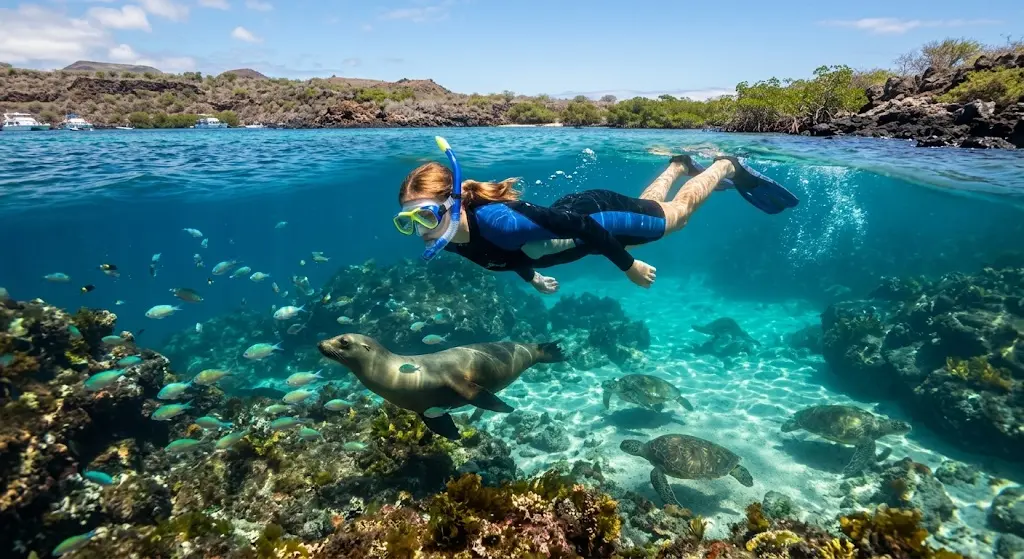
What compensates for the cold is biomass. Plankton blooms triggered by the upwelling feed schooling fish, which in turn concentrate sea lions, sea turtles, rays, reef sharks and — at the northern dive sites — whale sharks. Sea lion pupping peaks across several colonies, penguins forage actively in the west, and marine iguanas graze the shallows in numbers. This guide covers where those conditions align best, what gear the water demands, and how seasonal currents affect site selection across the central and southern islands.
| Specification / Metric | Detail / Value |
|---|---|
| Season | Cool / dry season (garúa), June to November |
| Water temperature (central islands) | 68–72°F / 20–22°C |
| Water temperature (western Isabela / Fernandina) | 64–66°F / 18–19°C |
| Air temperature range | 66–78°F / 19–26°C, frequently overcast |
| Underwater visibility | 30–65 ft / 10–20 m, variable with plankton density |
| Recommended wetsuit | 3 mm shorty minimum; 5 mm full suit for repeat entries |
| Main departure ports | Puerto Ayora (Santa Cruz), Puerto Baquerizo Moreno (San Cristóbal), Puerto Villamil (Isabela) |
| Typical day tour duration | 7–10 hours, including navigation |
| Key species in September | Galápagos sea lions, green sea turtles, white-tip reef sharks, golden and eagle rays, hammerheads, Galápagos penguins, marine iguanas |
| Sea conditions | Moderate to rough swell; strongest of the year at exposed sites |
| Snorkeling type | Deep-water (from panga) and shallow shore entries, depending on site |
| Regulatory framework | Galápagos National Park; certified naturalist guide mandatory at all visitor sites |
The Humboldt Current and Why September Water Runs Cold
The Galápagos sit at the convergence of three major oceanic systems. From May onward, the southeast trade winds strengthen and drive the cold Humboldt Current northward, while the Cromwell Undercurrent — a deep equatorial flow moving eastward — collides with the western slopes of Isabela and Fernandina and forces cold water toward the surface. The result is a shallow thermocline, a persistent low-altitude mist known locally as the garúa, and surface temperatures several degrees below the annual mean.
This upwelling delivers nitrates and phosphates into the photic zone, fuelling phytoplankton growth that supports the entire food chain. It is the reason a cluster of islands on the equator hosts penguins, fur seals and cold-water algae. September typically marks the coldest point of the cycle alongside August, which is why site selection and wetsuit thickness matter more this month than at almost any other time of year.
Water clarity behaves inversely to productivity. Dense plankton reduces visibility to around 30 feet at some sites, while sheltered bays and lava-walled channels can still deliver 60 feet or more. Conditions shift between morning and afternoon and between the leeward and windward sides of the same island, so operators frequently adjust the order of stops on the day of departure.
Seven Sites Where September Conditions Work in Your Favor
Kicker Rock (León Dormido) is the archipelago’s signature deep-water snorkel: an eroded tuff cone rising roughly 500 feet from the ocean floor, split by a narrow channel that funnels current and concentrates pelagic traffic. September delivers the highest probability of encountering Galápagos and scalloped hammerhead sharks, along with sea turtles and eagle rays. There is no shallow bottom and no beach — this is an open-water entry that suits confident swimmers. See the Kicker Rock day tour for departure logistics from San Cristóbal.
Pinzón Island, reached from Puerto Ayora, offers the calmer counterpart. Its protected coves keep swell out and hold consistently better visibility during the cool season, with reliable sightings of white-tip reef sharks resting on the sand and large schools of Creole fish and salemas. Swimmers unsure about open-water conditions typically find the Pinzón snorkeling tour more manageable; a direct comparison of both sites is worth reading before committing.
Los Túneles (Cabo Rosa), on southern Isabela, is a collapsed lava formation of arches and shallow channels. The interior is protected, shallow and unusually clear, making it the most forgiving site in this list. Green sea turtles, seahorses and juvenile white-tip sharks occupy the channels year-round. The Los Túneles excursion does require a crossing over an exposed bar, which September swell can complicate.
Las Tintoreras, minutes from Puerto Villamil, combines a short lava trail with a sheltered snorkel among marine iguanas, penguins and reef sharks in a narrow crevice. Water here is shallow, calm and among the coldest in the central-southern group. The Tintoreras tour is a half-day option and pairs well with a second site.
Santa Fe Island holds a broad, shallow bay with a resident sea lion colony that interacts freely with swimmers. Pupping activity peaks through the cool season, and September is one of the strongest months for close encounters. The Santa Fe snorkeling tour also passes endemic land iguanas and giant Opuntia cactus forest.
Lobos Island and Champion Islet off Floreana round out the practical options. Lobos is shallow, close to port and consistently calm; Champion attracts schooling fish and the endemic Floreana mockingbird nearby. Both suit travellers who want productive water without a long crossing.
Currents, Surge and Deep-Water Entries: What to Expect
September crossings are the roughest of the year. Trade winds generate a persistent southerly swell that makes exposed navigation legs uncomfortable for passengers prone to motion sickness, and medication should be taken before boarding rather than after symptoms begin. Sheltered sites are largely unaffected once the boat anchors.
Entry technique varies by site. Deep-water entries from a panga — standard at Kicker Rock and around offshore pinnacles — require entering directly into open ocean with no footing, holding position against moderate current, and returning to the boat on the guide’s signal. Shore and shallow entries at Las Tintoreras, Los Túneles and Lobos allow swimmers to stand. Anyone with limited swimming ability should confirm the entry type before booking, since operators cannot always modify it.
Guides also enforce distance rules underwater. Wildlife is habituated but not tame, and sea lions in particular are territorial during breeding season. Bull sea lions may approach and vocalise; the correct response is to withdraw calmly rather than hold position.
Wildlife Cycles Between August and November
September’s biological calendar is dense. Galápagos sea lion pupping continues across San Cristóbal, Española and Santa Fe, with nursing pups visible on beaches and juveniles active in the shallows — covered in more detail in this guide to sea lion viewing in September. Galápagos penguins forage aggressively in the cold water around Bartolomé and Isabela, and flightless cormorants nest along Fernandina’s coast.
Offshore, the cool season brings the archipelago’s largest visitors. Whale sharks pass Darwin and Wolf between June and November, though these northern sites are accessible only on liveaboard dive itineraries, not day tours. Humpbacks and Bryde’s whales are occasionally recorded in channels around Isabela; the question of whale sightings in September deserves its own treatment. Blue-footed boobies also perform courtship displays at several colonies during these months.
Park Regulations Every Snorkeler Must Follow
All marine visitor sites fall under the Galápagos National Park and the surrounding Marine Reserve. A certified naturalist guide is mandatory, group sizes are capped, and visitor numbers per site are regulated through a rotating schedule that limits daily pressure on any single location.
Core rules apply without exception: maintain a minimum distance of roughly six feet from all wildlife, never touch or feed animals, avoid contact with the seafloor, and use only reef-safe, oxybenzone-free sunscreen — or better, cover up with a rash guard instead. Removing shells, coral, sand or any biological material is prohibited, and drones require specific authorisation. Rangers conduct inspections, and operators risk losing permits for violations, so guide instructions are not negotiable.
Gear, Ports and Physical Requirements
Most operators supply mask, snorkel, fins and a shorty wetsuit as standard. In September this is often insufficient for anything beyond a single short entry; travellers planning multiple snorkel days should request a full 5 mm suit in advance or bring a neoprene top of their own. A rash guard, a windproof layer for the deck and a dry bag complete the essentials. Water shoes matter at sites with wet landings and lava shorelines.
Day tours run from three ports and generally involve 45 minutes to two hours of navigation each way. Physical demand is moderate: participants should be able to swim continuously for 30 minutes in open water and climb a boat ladder unassisted. For travellers weighing which excursions to prioritise, the day tour comparison guide breaks down duration, difficulty and wildlife focus across the main routes.
Final Thoughts on September as the Archipelago’s Productive Peak
September represents the Galápagos operating at maximum biological output. The same upwelling that makes the water uncomfortable is what sustains penguins on the equator, supports dense schooling fish, and draws hammerheads and whale sharks into the archipelago’s northern reaches. Understanding this connection reframes the cold water from an inconvenience into the defining mechanism of the ecosystem.
The practical implication for visitors is that site selection matters more in the cool season than at any other time. Exposed pinnacles reward strong swimmers with pelagic encounters that simply do not occur during the calm warm months; sheltered lava channels and shallow bays deliver clarity and comfort for everyone else. Choosing badly — booking a deep-water site without the swimming confidence to enjoy it — is the most common source of disappointment in these months, and it is entirely avoidable.
Beyond the individual itinerary, September conditions illustrate why the Galápagos Marine Reserve remains one of the most closely monitored marine protected areas on the planet. Nutrient-driven productivity of this intensity is rare at equatorial latitudes and highly sensitive to ocean-temperature anomalies; El Niño events that suppress upwelling have historically caused sharp declines in penguin, sea lion and marine iguana populations. Snorkelers visiting during the cool season are observing a system at its most vigorous — and one whose vigour depends on oceanographic conditions that are neither guaranteed nor permanent.
Frequently Asked Questions About Snorkeling in Galapagos in September
How cold is the water in the Galapagos in September?
Surface temperatures in the central islands typically range from 68 to 72°F (20 to 22°C). Western sites around Isabela and Fernandina, where the Cromwell Undercurrent upwells, can drop to 64–66°F (18–19°C). These are the coldest readings of the year alongside August.
Do I need a wetsuit to snorkel in Galapagos in September?
Yes. A 3 mm shorty is the minimum for a single short entry, and a 5 mm full suit is strongly recommended for anyone snorkelling on consecutive days or entering the water more than once per tour. Most operators include a shorty in the tour price but stock limited quantities of thicker suits, so request one when booking.
Is visibility good for snorkeling in September?
Visibility generally runs between 30 and 65 feet (10 to 20 metres). Plankton density reduces clarity compared with the warm season, but the same plankton attracts far more marine life. Sheltered sites such as Los Túneles and Pinzón hold clearer water than exposed locations.
Which snorkeling site is best for beginners in September?
Los Túneles on Isabela and Las Tintoreras are the most forgiving options, both offering shallow, protected water with standing depth. Lobos Island near San Cristóbal is another calm choice with short navigation. Kicker Rock should be avoided by weak swimmers, as it involves a deep-water entry with no shallow bottom.
Can you see hammerhead sharks while snorkeling in September?
Yes, though sightings are not guaranteed. Kicker Rock offers the highest probability from a day tour, where hammerheads and Galápagos sharks patrol the channel between the two rock formations. Encounters typically occur at depth below snorkellers rather than at the surface.
Are the boat crossings rough in September?
They can be. Southeast trade winds generate the strongest swell of the year during the cool season, and crossings to Pinzón, Santa Fe and Floreana are noticeably choppier than in the warm months. Motion sickness medication should be taken 30 to 60 minutes before departure. Conditions calm considerably once boats anchor at protected sites.