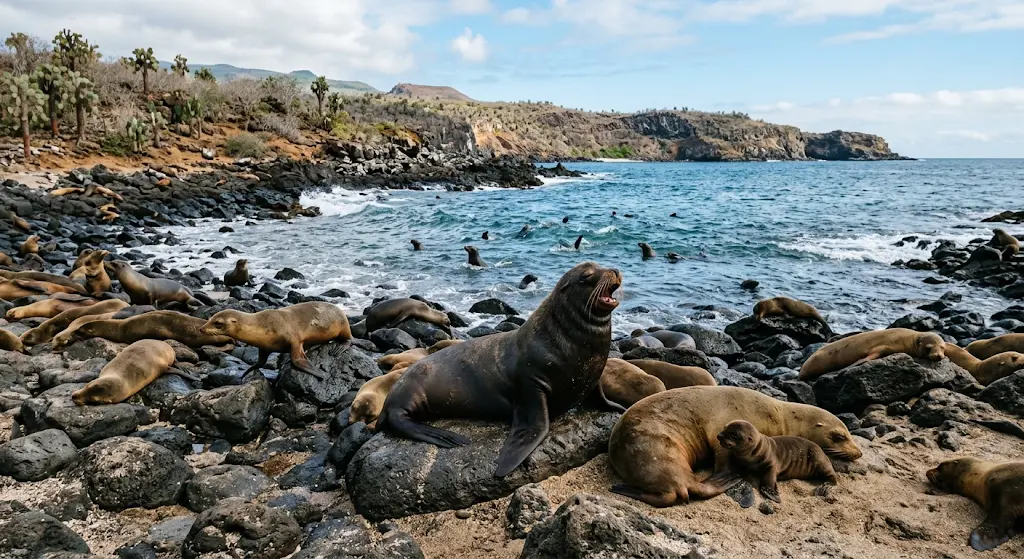
The Galápagos sea lion (Zalophus wollebaeki) is the most visible large mammal in the archipelago and, for most visitors, the first wild animal they encounter — often before leaving the pier at Puerto Baquerizo Moreno. September concentrates that visibility. The month sits at the core of the cool, dry garúa season, when the Humboldt Current pushes nutrient-rich water north and colonies respond with sustained foraging activity, dense beach haul-outs and, on several islands, large numbers of dependent pups.
Sea lions are not evenly distributed. Colonies cluster where three conditions overlap: sheltered landing beaches or low rock shelves, reliable access to cold upwelling, and minimal terrestrial disturbance. That geography explains why San Cristóbal, Española, Santa Fe and the islets around Isabela deliver consistently strong encounters, while other visitor sites offer only transient individuals.
This guide identifies the specific sites where sightings are most reliable in September, explains what the animals are doing during this part of their annual cycle, and outlines the Galápagos National Park regulations that govern how close visitors may approach. It also distinguishes the sea lion from its smaller, less commonly seen relative, the Galápagos fur seal (Arctocephalus galapagoensis), which occupies a different habitat entirely.
| Specification / Metric | Detail / Value |
|---|---|
| Primary species | Galápagos sea lion (Zalophus wollebaeki), endemic; IUCN Endangered |
| Secondary species | Galápagos fur seal (Arctocephalus galapagoensis), endemic; shaded lava habitat |
| Most reliable islands | San Cristóbal, Isla Lobos, Española, Santa Fe, North Seymour, Isabela islets |
| September breeding status | Active pupping and nursing at many colonies; territorial bulls patrolling |
| Sea surface temperature | Approx. 19–23 °C (66–73 °F); colder in the western sector |
| Air temperature range | Approx. 19–26 °C (66–79 °F), frequent overcast and coastal mist |
| Minimum approach distance | 2 metres (6 feet) from any wildlife; no touching or feeding |
| Recommended thermal gear | 3 mm full wetsuit or shorty; supplied by most licensed operators |
| Typical day tour duration | 6–9 hours, including navigation time |
| Guide requirement | Certified naturalist guide mandatory at all National Park visitor sites |
Why San Cristóbal Functions as the Archipelago’s Sea Lion Capital
San Cristóbal holds the densest and most accessible concentrations. The island’s eastern position exposes it to consistent upwelling, and its coastline offers a series of low-gradient beaches that require little energy for a heavy pinniped to climb. Playa Mann, a short walk from Puerto Baquerizo Moreno, and La Lobería, roughly ten minutes by taxi from town, both host resident groups year-round and can be visited without a tour. Sea lions also occupy benches, boat decks and the harbour boardwalk in the port itself, which is a legal grey area the park manages through signage rather than exclusion.
Offshore, Isla Lobos is the single most predictable site in the archipelago for in-water encounters with juveniles. The channel between the islet and San Cristóbal is shallow, sheltered and shallow enough that young animals use it as a training ground — which is precisely why they engage with snorkelers. A full circuit of the island’s coastline on the 360° San Cristóbal tour typically adds Kicker Rock and several additional haul-out points to the same itinerary.
Snorkeling Sites Where Sea Lions Actively Approach Swimmers
Beach observation and in-water interaction are different experiences. Juvenile sea lions initiate contact; adults generally ignore swimmers, and territorial males should be avoided outright. The sites below combine resident colonies with conditions suitable for snorkeling in September.
Kicker Rock (León Dormido) is a vertical tuff formation split by a narrow channel. Sea lions patrol the base while Galápagos sharks, hammerheads and rays move through the deeper water — a combination that makes this the archipelago’s best-known drift snorkel, though currents demand competent swimmers. Santa Fe Island offers the opposite profile: a protected turquoise bay with almost no current, a large resident colony spread across the shoreline, and the added interest of the endemic Santa Fe land iguana. Around Isabela, the calm lagoons of Las Tintoreras and the adjacent Concha de Perla channel provide easy, shallow water where sea lions, marine iguanas and penguins share the same few hundred metres.
Eastern and Central Colonies: Española, North Seymour and Santa Cruz
Española supports one of the archipelago’s largest breeding aggregations. Gardner Bay’s long white-sand beach functions as a nursery, and September visitors commonly find dozens of animals hauled out within a few metres of the landing zone. Because Española also holds the world’s only waved albatross colony — present until roughly December — the island delivers unusual species density for a single day trip.
North Seymour hosts smaller groups along its rocky southern shore, secondary to the island’s frigatebird and blue-footed booby colonies. On Santa Cruz, Playa Mansa at Tortuga Bay and the small beach at Las Grietas both see regular haul-outs, and the fish market in Puerto Ayora attracts opportunistic individuals waiting for scraps. Broader island itineraries such as the 180° Santa Cruz tour generally include at least one reliable colony.
What September Conditions Mean for Behaviour and Comfort
September represents the coldest and most productive stretch of the Galápagos year. Upwelling drives plankton blooms, which support the fish biomass that sea lions depend on, and colonies are correspondingly well-fed and active. The trade-off is thermal: water temperatures near 19–23 °C feel considerably colder than the December–May warm season, and a wetsuit is not optional for most snorkelers. Underwater visibility can also drop where plankton density is highest, particularly in the western sector.
Breeding timing varies across the archipelago rather than following a single archipelago-wide schedule. Broadly, colonies pup between May and January, with western and central islands starting earlier and eastern colonies later. In practice, September visitors encounter pups at most major colonies, alongside vocal territorial bulls defending stretches of beach. Further detail on conditions across the month is covered in the guide to visiting Galápagos in September.
Park Regulations, Safety and the Endangered Status of the Species
The Galápagos National Park requires visitors to maintain a minimum distance of two metres from all wildlife, prohibits touching, feeding or flash photography, and mandates that all visitor sites be accessed with a certified naturalist guide. These rules apply equally on land and in the water: swimming toward a sea lion is a violation even if the animal subsequently approaches you.
The safety rationale is practical as well as regulatory. Territorial males weigh up to 250 kilograms, defend defined stretches of coastline, and will charge intruders during breeding periods. Their behavioural warnings — head-shaking, open-mouth displays, sustained barking — should be treated as instructions to withdraw. Mothers with young pups are similarly defensive.
Conservation context matters here. Zalophus wollebaeki is classified as Endangered, with the population having declined substantially from twentieth-century levels. El Niño events, which suppress upwelling and collapse the food supply, drive severe mortality among pups and juveniles; introduced dogs, entanglement in fishing gear and disease transmission add further pressure. Disturbance at haul-out sites has a measurable energetic cost for animals already operating on tight margins. Additional species profiles are available in the overview of Galápagos wildlife.
Logistics, Gear and Choosing Between Itineraries
Day tours depart from the three inhabited port towns: Puerto Ayora (Santa Cruz), Puerto Baquerizo Moreno (San Cristóbal) and Puerto Villamil (Isabela). Navigation times range from roughly 30 minutes to Isla Lobos up to two and a half hours to Española, and open-water crossings in September can be choppy under the persistent southeast trade winds. Travellers prone to motion sickness should medicate before departure rather than en route.
Essential gear includes a 3 mm wetsuit (usually provided), reef-safe sunscreen, a windproof layer for exposed deck travel, closed-toe or secure water shoes for wet landings, and a dry bag. Cloud cover during the garúa season is deceptive: UV exposure at the equator remains high regardless of overcast skies. For those weighing options across islands, the comparison of Galápagos day tours outlines difficulty levels, durations and wildlife profiles side by side.
Final Thoughts
The abundance of sea lions across the Galápagos is a direct expression of oceanography. The archipelago sits at the convergence of the Humboldt, Cromwell and Panama currents, and the cold, nutrient-dense water arriving during the garúa season sustains a marine food web capable of supporting a large pinniped population on islands that are otherwise arid and resource-poor. September represents the seasonal peak of that productivity, which is why colonies appear so conspicuously healthy and active during this window.
That dependence also defines the species’ vulnerability. Galápagos sea lions have no meaningful buffer against oceanographic disruption: when El Niño conditions warm the surface water and suppress upwelling, prey disappears within weeks and pup mortality rises sharply. Population trajectories over recent decades track these events closely, and the Endangered listing reflects a species whose fortunes are tied to a narrow set of physical conditions rather than to habitat availability on land.
For visitors, this reframes what a sea lion encounter actually represents. The animals sprawled across Gardner Bay or circling snorkelers at Isla Lobos are not simply charismatic wildlife; they are indicators of a functioning upwelling system. Their density in a given year is one of the more legible measures of how the eastern Pacific is behaving. Observing them at the mandated distance, without altering their behaviour, costs nothing and preserves the integrity of a dataset that researchers, park managers and future travellers all depend on.
Frequently Asked Questions About Seeing Sea Lions in Galapagos in September
Which island guarantees the most sea lion sightings in September?
San Cristóbal is the most reliable. Sea lions occupy the town waterfront in Puerto Baquerizo Moreno, Playa Mann and La Lobería, all reachable on foot or by short taxi ride without booking a tour. For in-water encounters with playful juveniles, Isla Lobos — roughly 30 minutes by boat from the same port — has the highest consistency in the archipelago.
Do I need a wetsuit to snorkel with sea lions in September?
Yes for most people. September sea temperatures typically run between 19 and 23 °C, cold enough that unprotected swimmers lose heat within 20–30 minutes. Licensed operators generally include a 3 mm full wetsuit or shorty in the tour price; confirm at booking, and request a size when you reserve rather than on the morning of departure.
Are baby sea lions present in September?
Pups are common at most major colonies in September. Breeding is staggered across the archipelago rather than synchronised, spanning roughly May to January, with eastern islands such as Española and San Cristóbal generally pupping later in that window. Expect nursing pups on beaches and unattended youngsters waiting for mothers to return from foraging trips.
How close can I legally get to a sea lion?
Two metres is the National Park minimum for all wildlife, in the water and on land. If an animal closes that distance voluntarily, you should remain still rather than retreat suddenly or reach out. Touching, feeding and flash photography are prohibited, and guides are authorised to end an activity if visitors disregard these rules.
Are Galápagos sea lions dangerous?
Adult males can be. Territorial bulls defend beach sections during breeding periods and will charge, with bites capable of causing serious injury. Warning behaviours include head-shaking, open-mouth displays and repeated barking. Mothers with pups are also defensive. Juveniles and non-breeding adults pose no meaningful risk provided visitors keep their distance.
What is the difference between a Galápagos sea lion and a fur seal?
They are separate endemic species. Sea lions are larger, have shorter, coarser fur and haul out on open sand beaches. Fur seals are smaller, have a denser double-layered coat, larger eyes and a blunter snout, and shelter in shaded lava crevices to avoid overheating. Fur seals are most reliably seen at Puerto Egas on Santiago and at Punta Vicente Roca on Isabela — sites generally reached on multi-day cruises rather than day tours.