Wolf Island lies roughly 160 kilometers (100 miles) northwest of Isabela, on the same volcanic ridge as Darwin Island, and the only way to reach it is on a multi-day Galápagos liveaboard. By day it is known for schooling scalloped hammerheads, Galápagos sharks and, in the cool season, whale sharks. After sunset the same water works differently, and Wolf is one of the few places in the Galápagos Marine Reserve where a night dive appears on some itineraries.
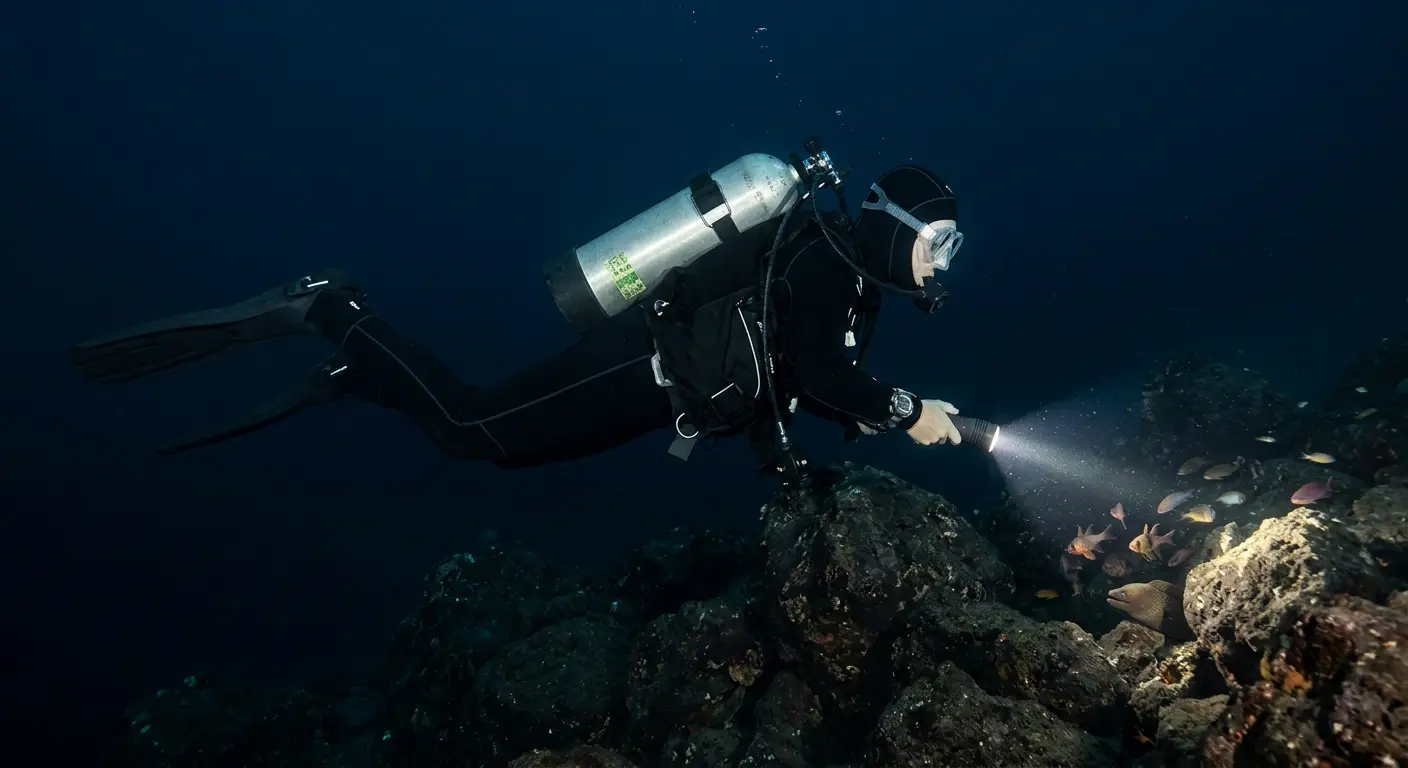
A night dive at Wolf is never guaranteed. It depends on the vessel’s schedule, the sea state, the guide’s judgement and the anchorages the Galápagos National Park allows. When it does happen, it is usually offered once per trip, either as an optional extra dive or in place of the late afternoon dive. It takes place in sheltered water near the anchorage, not on the exposed current points that made Wolf famous.
This guide covers how night diving fits into a Wolf Island itinerary, what tends to appear on the reef after dark, the conditions to plan for, and the rules and equipment that apply.
| Specification / Metric | Detail / Value |
|---|---|
| Location | Northern Galápagos, about 160 km northwest of Isabela |
| Access | Liveaboard only, with an overnight navigation from the central islands |
| Frequency | Usually one optional night dive per trip, subject to conditions |
| Setting | Sheltered reef near the overnight anchorage, kept relatively shallow |
| Water temperature | About 22 to 26 °C in the warm season; cooler from June to November |
| Common sightings | Moray eels, octopus, lobsters, red-lipped batfish, hunting whitetip reef sharks |
| Experience | Advanced Open Water or equivalent, plus prior night dives recommended |
| Required gear | Primary and backup dive lights, tank light or strobe, surface signal device |
An Isolated Volcano Where the Yacht Stays Overnight
Wolf is the eroded summit of a volcano rising from deep ocean water, ringed by sheer cliffs and boulder slopes. There is no visitor landing site, so every encounter happens underwater or from the deck. Together with Darwin, the island lies inside the Darwin and Wolf Marine Sanctuary, a no-take zone created in 2016 to protect one of the highest concentrations of sharks recorded anywhere. The Darwin and Wolf diving guide covers the daytime sites in detail.
Location explains why night dives are rare in the Galápagos and why Wolf is an exception. On most nights a liveaboard is either navigating between islands or anchored somewhere with no safe dive point nearby. Wolf itineraries usually include at least one overnight anchorage in the island’s lee, which gives the crew calm water, a short panga ride and a reef they already know from the day’s dives.
The Reef Community That Takes Over After Sunset
The hammerhead schools that define Wolf by day generally stay in deeper, open water, so a night dive is not a shark spectacle in the daytime sense. It is a close look at the reef as the night shift takes over. The most frequent encounters include:
- Moray eels, including fine-spotted morays, which leave their crevices and hunt in the open across the boulders.
- Whitetip reef sharks, which rest on the bottom during the day and become active hunters at night, often working the rocks in small groups.
- Octopus, crabs and lobsters, which forage openly and change color quickly under torchlight.
- Red-lipped batfish, which shuffle across sandy patches on modified fins and are far easier to find at night.
- Reef fish resting in cracks, including parrotfish and squirrelfish, alongside invertebrates that stay hidden by day.
When divers cover their lights for a moment, bioluminescent plankton often sparkles with each movement of a fin. Sea lions are occasionally reported investigating torch beams, since artificial light makes small fish easier for them to catch. For a wider view of the archipelago’s species, see the overview of Galápagos Islands animals.
How a Night Dive at Wolf Is Run
The dive begins with a briefing on the mother ship covering entry, light signals, buddy procedure and the pickup plan. Divers board the pangas at dusk, roll in backward and descend as a group behind a naturalist dive guide. Profiles are kept relatively shallow, and bottom time typically runs from 45 to 50 minutes, depending on air consumption and temperature.
Wolf has strong currents and surge, especially near the shore, and night does not change that. Guides choose a sheltered section of reef and cancel the dive if swell or current makes the pickup unsafe. Each diver carries a tank light or strobe so the group stays visible, and the panga crew tracks the bubbles and lights from the surface. Losing track of a buddy is the main hazard after dark, so staying close to the guide is not optional.
Warm Season, Cool Season and the Night Dive Window
From December to May the warm season brings calmer seas, water of roughly 22 to 26 °C and frequent manta sightings during the day. This is when operators are most likely to swap the fourth dive of the day for a night dive. From June to November the cool season brings rougher seas, cooler water and the peak season for whale sharks, roughly July to October. Night dives still happen in these months, but cancellations for sea state are more common.
Visibility at Wolf varies by season and by day, but at night the limiting factor is the torch beam rather than the water itself. A 5 to 7 mm wetsuit with a hood is standard for most of the year, because body heat drops faster when moving slowly along a reef in the dark.
Park Regulations That Apply After Dark
The Galápagos National Park sets the order of islands on each itinerary, and night dives are only allowed at approved points. Every dive is led by a certified naturalist dive guide, with groups of no more than eight divers per guide. Gloves are not permitted anywhere in the marine reserve, which keeps divers from holding onto the reef.
At night, the rules translate into specific habits. Keep lights angled at the edge of a subject rather than holding them straight on an animal’s eyes. Stay off the bottom to avoid kicking up sand and crushing small invertebrates, and never touch, feed or follow wildlife. Fishing is banned throughout the sanctuary, and the same no-contact principle applies to divers.
Experience, Equipment and Choosing a Vessel
Most operators ask for Advanced Open Water certification and a minimum number of logged dives, often between 30 and 50, before accepting guests on a Wolf and Darwin route. Prior night dives are strongly recommended, because Wolf is not the place for a first night dive. Bring a reliable primary light, a backup light and a surface marker buoy, and check whether your vessel provides lights or expects guests to bring their own.
Night dive policies differ between boats, so it is worth confirming before booking. The Galapagos Sky liveaboard includes an optional night dive during its days at Wolf and Darwin, and guests must bring their own lights for it. The Tiburon Explorer lists a possible night dive on its Wolf Island day, and the Humboldt Explorer anchors overnight at Wolf, with night dives depending on conditions. Other Wolf and Darwin routes, such as the Galapagos Aggressor III, follow their own schedules, and the full fleet is listed on the Galápagos diving cruises page.
Reading Wolf Island After Sunset
A night dive at Wolf reveals a side of the northern Galápagos that daytime diving hides. The large pelagic animals that draw divers to the island depend on a reef system that works around the clock, and after dark that system shifts toward predators and scavengers that stay out of sight in daylight. Moray eels, whitetip reef sharks and octopus become the most visible animals on the reef, and their behavior shows how energy moves through a food web that daytime diving rarely shows.
The rarity of night diving in the archipelago is a management choice, not an oversight. Remote anchorages, strong currents and strict park oversight keep the number of night dives low, which limits disturbance to wildlife that has very little exposure to artificial light. The status of Darwin and Wolf as a fully protected sanctuary reinforces that approach, and it is a large part of why shark densities around both islands remain exceptional on a global scale.
For divers, the practical conclusion is simple. A night dive at Wolf is an optional addition to an itinerary built around daytime encounters, and it rewards preparation more than luck. Confirming the vessel’s policy, bringing well-maintained lights and arriving with real night diving experience are what turn a possible dive into one that actually takes place.
Frequently Asked Questions About Night Diving at Wolf Island
Is night diving allowed at Wolf Island?
Yes. Wolf is one of the few places in the Galápagos Marine Reserve where night dives are permitted, at approved points close to the overnight anchorage. Each dive still depends on the itinerary approved by the Galápagos National Park and on the sea conditions that evening.
How many night dives are included on a Wolf and Darwin liveaboard?
Usually one at most, and it is optional. Some vessels offer it as an extra dive, while others replace the late afternoon dive with it. Not every departure includes one, so confirm the policy with the operator before booking.
What can you see on a night dive at Wolf Island?
The reef community is the focus. Moray eels, octopus, lobsters and crabs hunt in the open, whitetip reef sharks patrol the rocks, and red-lipped batfish move across sandy patches. Bioluminescent plankton is often visible when lights are covered.
What diving experience is needed for a night dive at Wolf?
Most operators require Advanced Open Water certification and a minimum number of logged dives, often between 30 and 50. Previous night dives are strongly recommended because of Wolf’s currents, surge and remote location.
Do I need to bring my own dive light?
On many vessels, yes. Plan on a primary light, a backup light and a tank light or strobe. Some liveaboards rent lights on board, but availability is limited, so check before departure.
Can you dive Wolf Island at night on a day trip from Santa Cruz?
No. Wolf is too remote for day boats, and only liveaboards reach it after an overnight navigation. The comparison of liveaboard versus day diving in Galápagos explains which sites each option covers.