
Island hopping means sleeping in hotels on the three main inhabited islands, San Cristóbal, Santa Cruz and Isabela, moving between them by public speedboat and reaching the uninhabited islands on guided day tours. It costs less than most cruises, gives you a fixed bed every night and lets you choose each excursion separately.
The trade-off is logistics. Ferries run on fixed schedules, flights land on only two islands, and some of the best day tours sell out weeks ahead. A badly ordered week can lose a full day to backtracking or put you on two open-water crossings in a single afternoon.
The itinerary below is built to avoid both problems. It uses an open-jaw flight, arriving on San Cristóbal and leaving from Baltra, so you cross the archipelago in one direction and never repeat a ferry route.
| Day | Island | Main Activity | Overnight |
|---|---|---|---|
| 1 | San Cristóbal | Arrival, Interpretation Center, gear fitting | Puerto Baquerizo Moreno |
| 2 | San Cristóbal | Kicker Rock snorkeling tour | Puerto Baquerizo Moreno |
| 3 | Santa Cruz | Morning ferry, highland tortoises | Puerto Ayora |
| 4 | Santa Cruz | North Seymour or Bartolomé day tour | Puerto Ayora |
| 5 | Isabela | Morning ferry, Las Tintoreras in the afternoon | Puerto Villamil |
| 6 | Isabela | Los Túneles or Sierra Negra | Puerto Villamil |
| 7 | Santa Cruz | Early ferry, transfer to Baltra airport | Departure |
How the Three Inhabited Islands Connect
Two airports serve the archipelago, one on Baltra, just north of Santa Cruz, and one in Puerto Baquerizo Moreno on San Cristóbal. Isabela has no regular commercial flights from the mainland, so it is reached by sea.
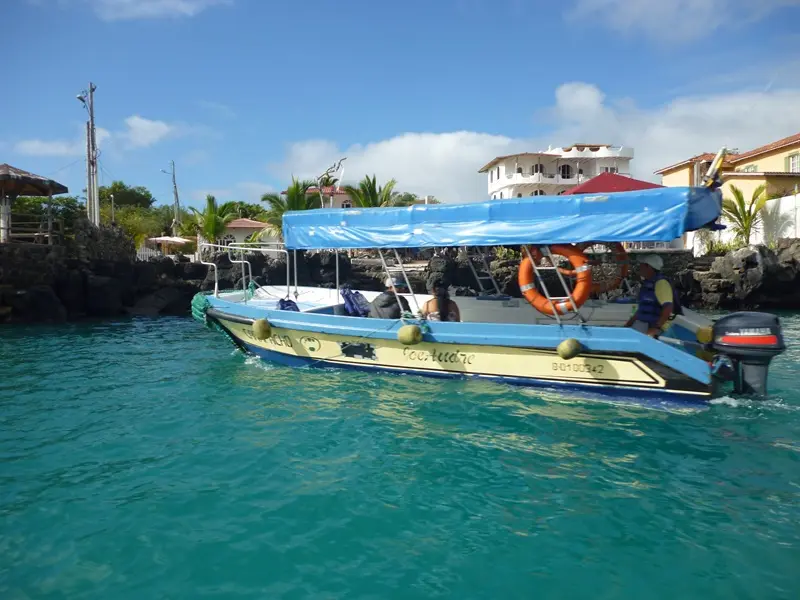
Inter-island ferries are small fiberglass speedboats carrying a few dozen passengers. Santa Cruz is the hub: routes run from Puerto Ayora to Puerto Villamil on Isabela and to Puerto Baquerizo Moreno on San Cristóbal, usually with a morning departure around 7 AM and an afternoon departure in the opposite direction. Each crossing takes roughly two hours. There is no practical direct link between San Cristóbal and Isabela, which is why the route above runs San Cristóbal, Santa Cruz, Isabela, then back to Santa Cruz for the flight.
Tickets typically cost USD 35 to 60 one way, depending on where you book. Our sister site sells Galápagos ferry tickets with confirmed seats, which matters most in December, July and August, when boats fill.
Days 1 and 2 on San Cristóbal
Fly into San Cristóbal and walk to town in minutes. The afternoon suits the Interpretation Center, the trail to Cerro Tijeretas and the sea lion colony along the malecón. If you plan to snorkel Kicker Rock the next day, complete the mandatory equipment fitting this afternoon, since the operator will not take you out without it.
Day 2 is the Kicker Rock day tour, which departs at 07:00 and spends around eight hours on the water. The central channel between the two rock towers is where scalloped hammerheads, Galápagos sharks and eagle rays pass, and snorkelers need to be confident swimmers in deep water. Travelers who prefer an easier day can swap it for a half-day trip to Isla Lobos.
Days 3 and 4 on Santa Cruz
Take the morning ferry to Puerto Ayora. The crossing arrives late morning, which leaves the afternoon for the highlands, where wild giant tortoises graze on private ranches such as El Chato, and for the lava tunnels nearby.
Day 4 is the main Santa Cruz excursion. The Bartolomé Island day tour combines a 400-step climb to the Pinnacle Rock viewpoint with snorkeling at Sullivan Bay, while North Seymour focuses on nesting frigatebirds and blue-footed boobies along a flat trail. Both are reached only by licensed day boats on fixed schedules, so they are the tours to reserve first when you book the trip.
Days 5 and 6 on Isabela
The 7 AM ferry reaches Puerto Villamil in time for lunch. In the afternoon, Las Tintoreras offers a short boat ride, a lava trail past a crevice where whitetip reef sharks rest, and a sheltered snorkel where Galápagos penguins are often seen. Isabela charges a small municipal dock fee on arrival, paid in cash.
Day 6 requires a choice. The Los Túneles snorkeling tour takes you to collapsed lava arches where seahorses, turtles and whitetip sharks shelter in calm water. The Sierra Negra volcano trek is a 16 km hike along one of the largest volcanic calderas on Earth and needs no boat at all. Adding a third night on Isabela lets you do both.
Day 7 and the Return Flight
Early ferries leave Isabela for Santa Cruz shortly after dawn. From Puerto Ayora, a taxi crosses the island in about 45 minutes, followed by a short boat ride over the Itabaca Channel to Baltra. Book a flight leaving around midday or later to keep a buffer for sea conditions.
Costs and Bookings to Plan Ahead
Every foreign adult pays the USD 200 Galápagos National Park fee on arrival, in cash, and USD 100 for children under 12. The Transit Control Card costs USD 20 and is bought at the Quito or Guayaquil airport before check-in. Our breakdown of Galápagos day tour prices covers what each excursion costs and includes.
Two crossings in the morning and three in total make this a sea-heavy week. Travelers prone to motion sickness should read our notes on seasickness on Galápagos day tours before booking, and those weighing a boat-based trip can compare with our guide to how long a Galápagos cruise should be.
Is Island Hopping the Right Way to See Galápagos?
Island hopping works best for travelers who value flexibility and a lower total cost over maximum coverage. It concentrates on the central and southern islands within reach of the three ports, which hold a large share of the wildlife most visitors come to see: sea lions, giant tortoises, marine iguanas, boobies, sharks and penguins. Each day ends on land, which also suits families and travelers who sleep badly at sea.
What it cannot easily reach are the remote western and northern islands, such as Fernandina and Genovesa, where many of the archipelago’s most specialized species live. Those sites belong to cruise itineraries, and no combination of day tours replaces them. A land-based week is a different experience rather than a smaller version of a cruise, and the two can be combined on a longer trip.
The model also supports the inhabited islands directly. Spending on hotels, local guides, restaurants and ferries stays in Puerto Ayora, Puerto Villamil and Puerto Baquerizo Moreno, the communities that live alongside the national park. For many travelers, that balance between access, cost and local economic benefit is the strongest argument for planning the trip this way.
Frequently Asked Questions About Galápagos Island Hopping
Is 7 days enough for island hopping in Galápagos?
Seven days covers three islands with two nights on each, which is the practical minimum. With fewer days, drop San Cristóbal or Isabela rather than rushing all three, since each transfer uses most of a morning.
Can you take a ferry from San Cristóbal directly to Isabela?
There is no practical direct ferry between San Cristóbal and Isabela. Travelers connect through Santa Cruz, which is why a one-way route that starts on San Cristóbal and ends near Baltra avoids repeated crossings.
How much do the inter-island ferries cost?
Speedboat tickets typically cost between USD 35 and 60 per person one way, depending on the seller. Prices are fixed by route, but seats are limited, so booking ahead is safer in high season.
Do I need to book Galápagos day tours in advance?
Tours to Bartolomé and North Seymour run on licensed boats with fixed capacity and should be reserved weeks ahead. Shorter tours on Isabela and San Cristóbal can often be confirmed a few days before.
Which island is best for the first night?
San Cristóbal works well because the airport is inside the town and the afternoon can be spent on foot. Arriving at Baltra adds a transfer of about an hour before reaching Puerto Ayora.
Is island hopping cheaper than a cruise?
In most cases it is, especially compared with first class and luxury boats. The savings depend on hotel category and the number of tours, but a land-based week usually costs less than a cruise of the same length.